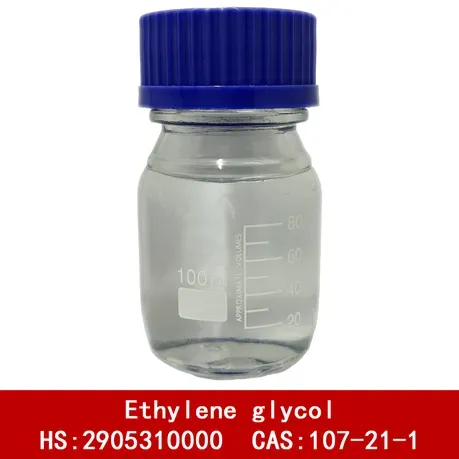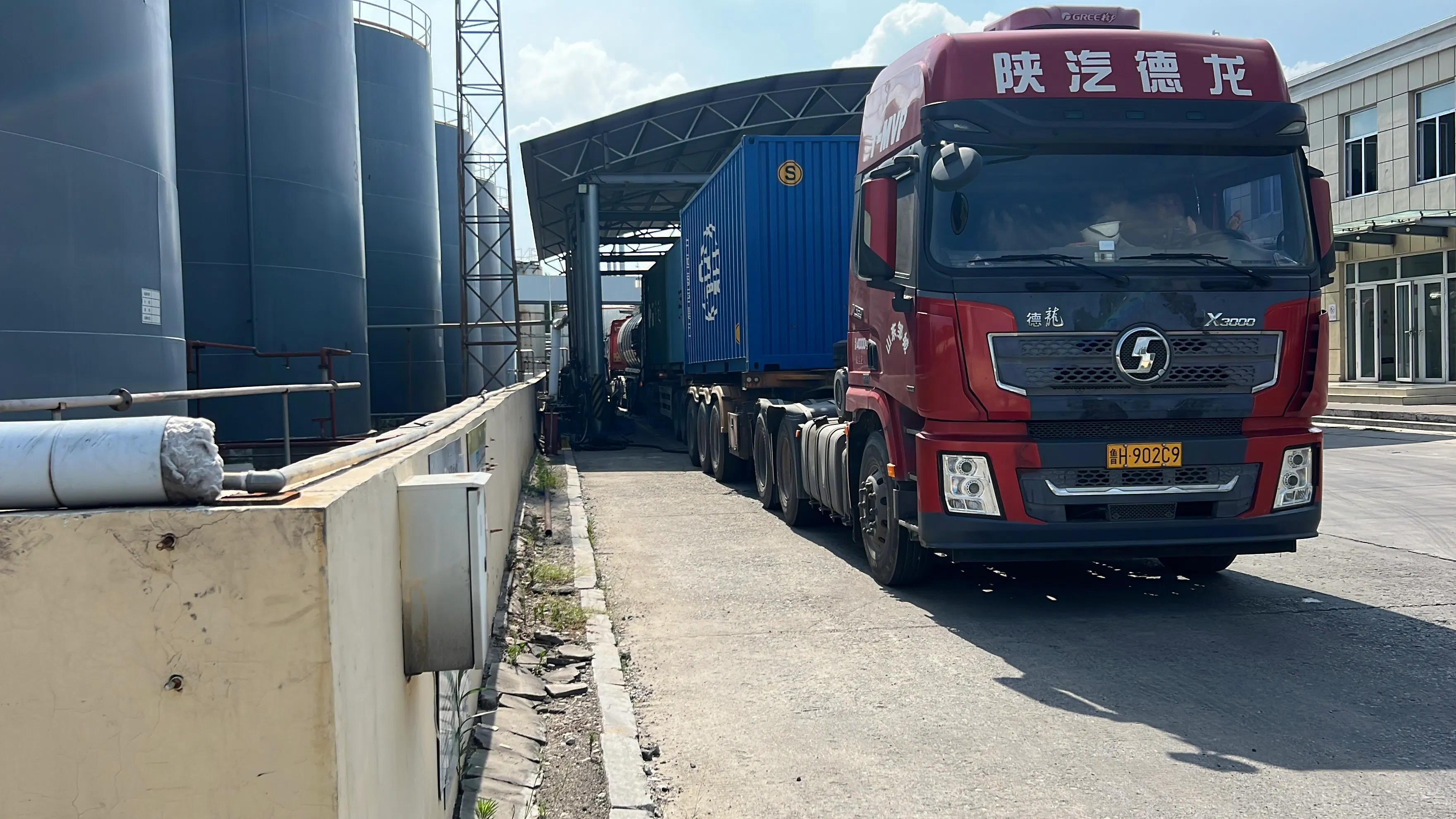

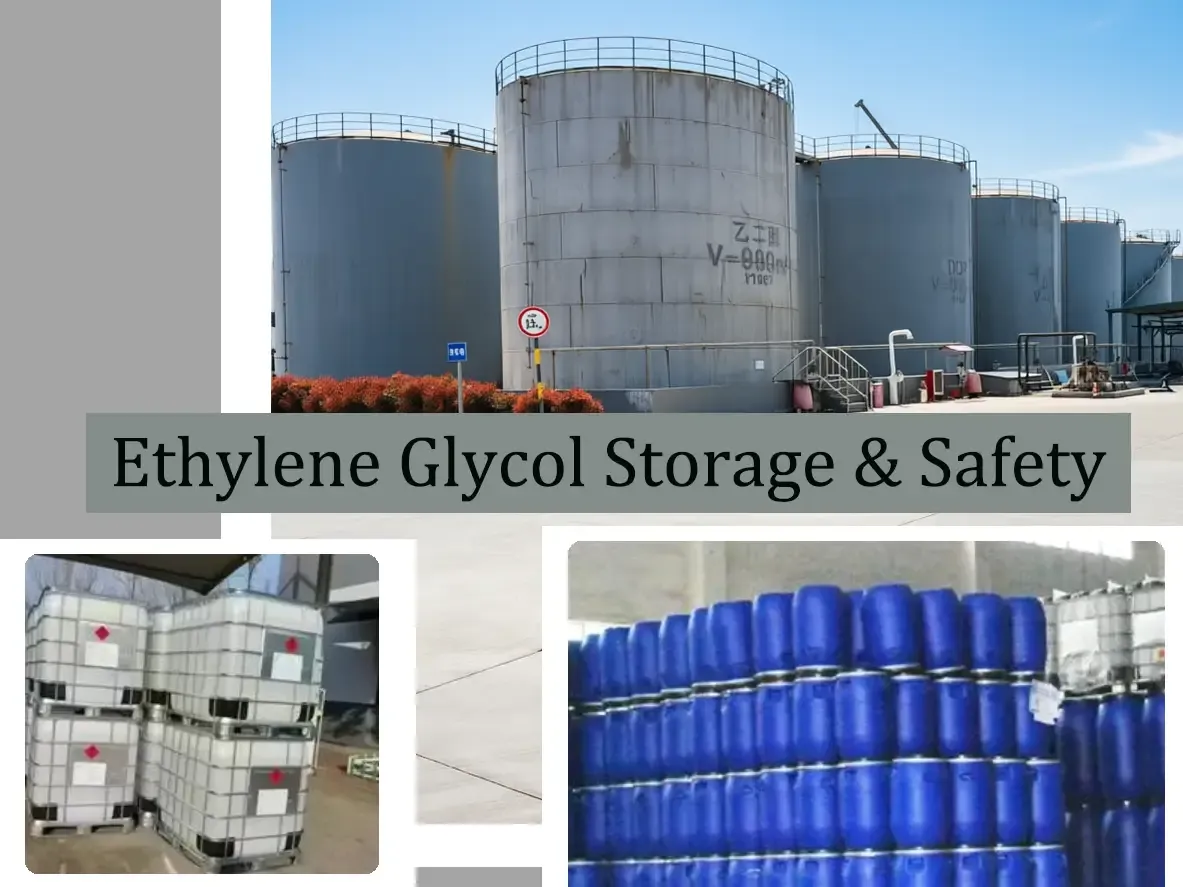
Proper ethylene glycol storage is essential for every facility that handles MEG (Monoethylene Glycol, CAS 107-21-1) — whether you are an antifreeze manufacturer, a hydraulic fluid compounder, or a chemical distributor. MEG is hygroscopic, toxic if ingested, and classified as a hazardous substance under OSHA and EU CLP regulations. Incorrect storage can lead to moisture absorption, quality degradation, and serious health risks. This guide covers everything you need to know about MEG storage conditions, safe handling procedures, spill response, and regulatory compliance — information that complements our ethylene glycol antifreeze and coolant guide and MEG price trends analysis.
Key Takeaways
- MEG is hygroscopic — it absorbs moisture from air, which can degrade purity below the ≥99.5% threshold required for antifreeze and hydraulic fluid production.
- Store MEG in sealed stainless steel or HDPE containers at 5–35 °C, away from direct sunlight and incompatible chemicals (strong oxidizers, strong acids).
- MEG is toxic if ingested (oral LD₅₀ ~4,700 mg/kg in rats) — proper PPE, labeling, and spill response procedures are mandatory under OSHA 29 CFR 1910.1200 and EU CLP.
- Recommended shelf life is 24 months under ideal conditions; quality testing is required beyond this period.
- Shandong Changxing supplies MEG with complete SDS, CoA, and GHS-compliant documentation for safe storage and handling.
Why Proper Ethylene Glycol Storage Matters
MEG is one of the most widely used industrial chemicals globally, with over 30 million metric tons produced annually [source: S&P Global Commodity Insights]. Its applications span antifreeze formulations, water-glycol hydraulic fluids, heat transfer systems, and chemical intermediate production. But unlike many bulk chemicals, MEG presents a unique combination of hazards and sensitivities that demand careful storage management:
- Hygroscopicity: MEG absorbs atmospheric moisture rapidly. An open container in a humid environment can gain 0.5–1.0% water content within hours, pushing purity below the ≥99.5% specification required for antifreeze and coolant production. For details on purity requirements, see our antifreeze formulation guide.
- Toxicity: MEG has an oral LD₅₀ of approximately 4,700 mg/kg in rats, making it harmful if swallowed. Its sweet taste creates an ingestion hazard, particularly around children and animals. Metabolism produces oxalic acid, which can cause kidney failure.
- Environmental hazard: Spilled MEG is toxic to aquatic life with long-lasting effects (Aquatic Chronic 3 under EU CLP). Uncontained spills can contaminate soil and groundwater.
- Quality sensitivity: Chloride contamination above 1.0 ppm causes pitting corrosion in aluminum heat exchangers; iron above 0.5 ppm accelerates inhibitor depletion in coolant formulations.
Ethylene Glycol Storage Conditions
Temperature Requirements
MEG has a freezing point of −12.9 °C (8.7 °F) and a boiling point of 197.3 °C (387.1 °F). The recommended storage temperature range is 5–35 °C (41–95 °F):
| Condition | Temperature Range | Impact on MEG |
|---|---|---|
| Ideal storage | 5–35 °C | Stable viscosity, minimal moisture absorption, no degradation |
| Cold weather (<−10 °C) | Below −12.9 °C | MEG freezes; viscosity increases dramatically below 0 °C making pumping difficult |
| Hot weather (>40 °C) | Above 40 °C | Accelerated oxidation, increased moisture absorption, potential degradation |
| Heated storage | 15–25 °C (with insulation) | Recommended for cold-climate bulk tanks; use low-density electric heating or steam tracing |
Important: If MEG has frozen, thaw gradually at room temperature (15–25 °C). Do not use direct flame or steam injection on the container exterior, as uneven heating can cause thermal stress and container damage. After thawing, verify purity and water content before use.
Container and Tank Materials
Selecting the right container material is critical for long-term MEG storage quality:
| Material | Compatibility | Best For |
|---|---|---|
| Stainless steel (304/316) | ✅ Excellent | Long-term bulk storage; preferred for antifreeze/hydraulic-grade MEG |
| Carbon steel (epoxy-lined) | ✅ Good | Bulk storage with proper lining; inspect lining annually |
| HDPE (high-density polyethylene) | ✅ Good | Drums, IBC totes; suitable for up to 24 months |
| Mild steel (unlined) | ⚠️ Conditional | Short-term only; risk of iron contamination and rust |
| Copper / brass | ❌ Not recommended | Copper ions catalyze MEG oxidation and degrade quality |
Key rule: All containers must be tightly sealed when not in active use. Open containers allow moisture ingress and accelerate oxidation. For bulk tank storage, install desiccant breathers on vent lines to prevent atmospheric moisture from entering during tank breathing cycles.
Ventilation and Indoor Storage
MEG storage areas must be well-ventilated, dry, and protected from the elements:
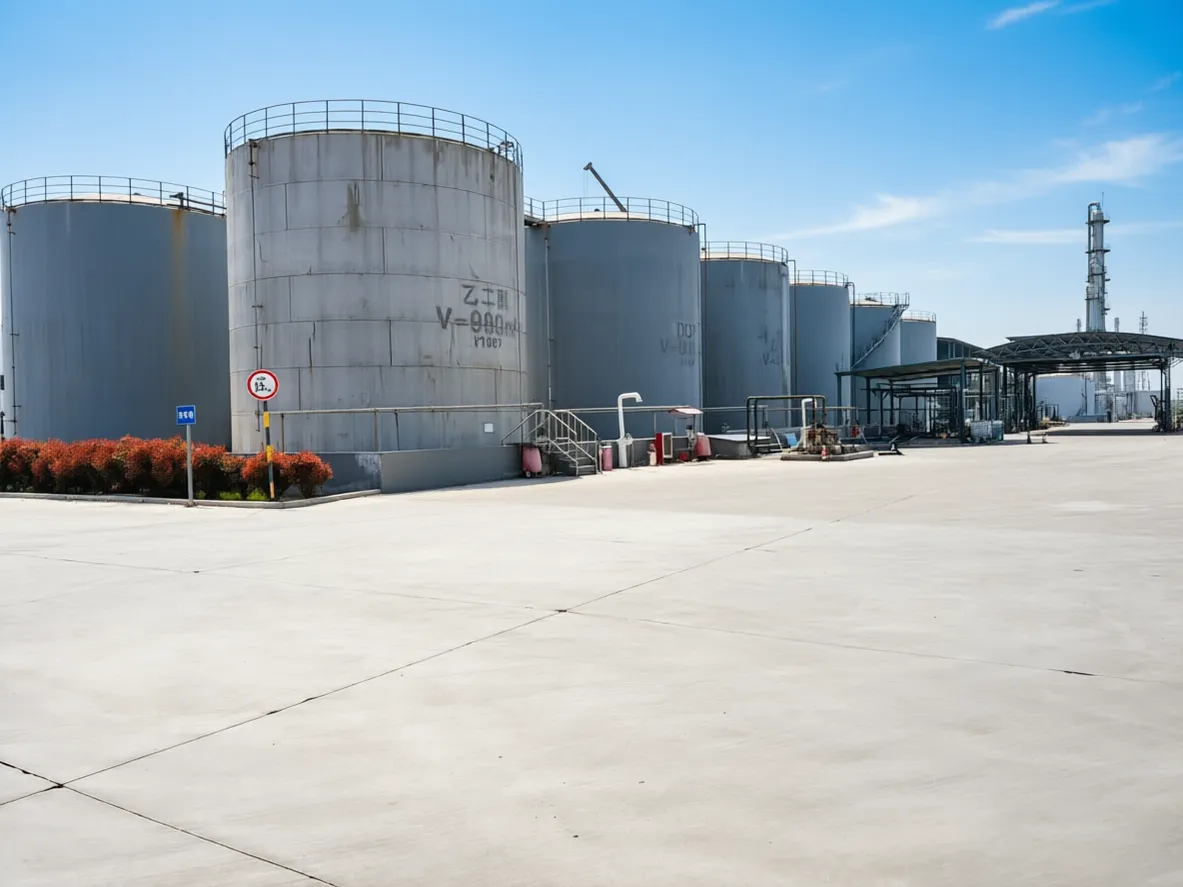
- Indoor storage is strongly preferred. Outdoor storage exposes MEG to temperature fluctuations, UV radiation, and rain ingress.
- Ensure adequate ventilation — MEG vapor pressure is very low at room temperature (0.06 mmHg at 20 °C), but in enclosed spaces with elevated temperatures, vapor accumulation can occur. Natural or mechanical ventilation at 6–12 air changes per hour is recommended.
- Keep away from heat sources — maintain minimum 2-meter clearance from steam pipes, furnaces, and electrical equipment.
- Secondary containment is mandatory — bulk tanks must have containment basins capable of holding 110% of the largest tank's volume, per EPA 40 CFR 264.175 and equivalent local regulations.
- Segregate from incompatible materials — store MEG away from strong oxidizers (perchlorates, permanganates), strong acids (sulfuric, nitric), and chlorinated solvents.
Safe Handling Procedures for Ethylene Glycol
Personal Protective Equipment (PPE)
Under OSHA 29 CFR 1910.132 and EU Regulation (EC) No 1907/2006 (REACH), employers must provide appropriate PPE for workers handling MEG:
| PPE Item | Specification | When Required |
|---|---|---|
| Chemical-resistant gloves | Nitrile or butyl rubber (breakthrough time >8 hours) | All handling operations |
| Safety goggles / face shield | Splash-proof (ANSI Z87.1 or EN 166) | Pouring, pumping, sampling |
| Protective clothing | Chemical-resistant apron or coveralls | Bulk transfer operations |
| Respiratory protection | Not normally required; use organic vapor cartridge if mist is present | Spray applications or heated operations only |
Hygiene practices: Wash hands thoroughly with soap and water after handling MEG, before eating, drinking, or smoking. Remove contaminated clothing before entering break rooms or offices. Do not store food or beverages in MEG handling areas.
Transfer and Pumping Operations
When transferring MEG between containers or tanks, follow these safety practices:
- Use closed transfer systems wherever possible — hard-piped connections with dry-break couplings minimize exposure and moisture ingress.
- Ground and bond all containers during transfer — although MEG is not classified as flammable (flash point 111 °C closed cup), static discharge can ignite vapors in confined spaces at elevated temperatures.
- Inspect hoses and fittings before each transfer — check for cracks, leaks, and proper seal integrity. Replace worn gaskets immediately.
- Monitor for leaks during pumping — position drip trays under connection points. A leak rate of just 1 drop per second wastes over 1,300 liters per year.
- Never siphon by mouth — MEG's sweet taste makes accidental ingestion a serious risk during mouth-started siphoning.
Ethylene Glycol Toxicity and Health Hazards
Understanding MEG's health hazards is critical for safe storage and handling. Under the Globally Harmonized System (GHS) and EU CLP Regulation (EC) No 1272/2008, MEG is classified as:
| Hazard Category | GHS Classification | Details |
|---|---|---|
| Acute toxicity (oral) | Category 4 — H302 | Harmful if swallowed (LD₅₀ ~4,700 mg/kg, rat) |
| Specific target organ toxicity (repeated exposure) | Category 2 — STOT RE 2, H373 | May cause damage to kidneys through prolonged or repeated exposure |
| Environmental hazard | Aquatic Chronic 3 — H412 | Harmful to aquatic life with long-lasting effects |
Metabolic pathway: When ingested, MEG is metabolized by the liver enzyme alcohol dehydrogenase into glycolaldehyde, then glycolic acid, and finally oxalic acid. Oxalic acid binds with calcium to form calcium oxalate crystals, which deposit in the kidneys and can cause acute renal failure. The lethal dose in humans is estimated at 1.0–1.6 mL/kg of body weight [source: ATSDR Toxicological Profile for Ethylene Glycol]. This is why MEG must never be used in food, beverage, or pharmaceutical applications — for those uses, propylene glycol is the safe alternative.
Spill Response and Emergency Procedures
Every MEG storage facility must have a documented spill response plan. Here is the standard procedure:
- Evacuate non-essential personnel from the immediate area. Assess the spill size and potential for spread.
- Contain the spill — use absorbent booms, sand, or vermiculite to prevent spread into drains, waterways, or soil. MEG is water-soluble and will quickly contaminate water sources.
- Wear appropriate PPE — chemical-resistant gloves, goggles, and protective clothing as described above.
- Collect spilled material — for small spills (<20 liters), absorb with inert material and place in sealed containers for disposal. For large spills, use vacuum trucks with chemical-resistant hoses.
- Do not flush with water — MEG is water-soluble and flushing will spread contamination. Use dry cleanup methods.
- Dispose of contaminated material as hazardous waste per local regulations (RCRA in the US, Waste Framework Directive in the EU).
- Report spills to regulatory authorities if the quantity exceeds reportable thresholds — in the US, CERCLA requires reporting of MEG releases ≥5,000 pounds (≈2,268 kg).
First aid measures:
- Ingestion: Do NOT induce vomiting. Rinse mouth with water. Seek immediate medical attention. Administer fomepizole (alcohol dehydrogenase inhibitor) if available and directed by medical personnel.
- Skin contact: Remove contaminated clothing. Wash skin with soap and water for at least 15 minutes.
- Eye contact: Rinse cautiously with water for at least 15 minutes. Remove contact lenses. Seek medical attention if irritation persists.
- Inhalation: Move to fresh air. If breathing is difficult, administer oxygen and seek medical attention.
MEG Shelf Life and Quality Monitoring
Under ideal storage conditions (sealed containers, 5–35 °C, dry environment), MEG has a recommended shelf life of 24 months from the date of manufacture. However, MEG does not "spoil" in the traditional sense — it degrades gradually through moisture absorption and oxidation.
Quality monitoring schedule for stored MEG:
| Storage Duration | Testing Frequency | Key Parameters to Monitor |
|---|---|---|
| 0–12 months | No testing required (if sealed) | Visual inspection only — check for container integrity and labeling |
| 12–24 months | Quarterly | Water content (Karl Fischer), purity (GC), chroma (Pt-Co), acid value |
| >24 months | Monthly | Full specification testing — purity, water, chloride, iron, chroma, acid value, DEG content |
Acceptance criteria for continued use beyond 24 months:
- Purity ≥99.0% (antifreeze/hydraulic grade requires ≥99.5%)
- Water content ≤0.3% (specification is ≤0.1% for fresh product)
- Chroma ≤60 Pt-Co (specification is ≤40 for fresh product)
- Acid value within specification
- No visible contamination or particulate matter
If any parameter falls outside specification, the MEG can often be reprocessed through vacuum distillation or molecular sieve drying to restore quality — but this adds cost and complexity that proper storage practices prevent.
Transportation and Shipping Classification
MEG is classified as a non-dangerous good for transport under most international regulations, which simplifies logistics but does not eliminate handling precautions:
| Regulation | Classification | Implication |
|---|---|---|
| UN/IMDG (maritime) | Not regulated as dangerous goods | Standard containerized shipping; no UN number required |
| ADR (European road) | Not regulated | Standard road transport; no hazard label required |
| IATA/ICAO (air) | Not regulated | Standard air cargo; no special packaging requirements |
| US DOT (49 CFR) | Not regulated in bulk packaging | Standard freight; GHS-compliant SDS must accompany shipment |
Common MEG packaging options include: flexitanks (20–24 tons per 20-foot container), IBC totes (1,000 kg each), 200-liter steel or HDPE drums, and ISO tanks for bulk shipments. For current packaging options and shipping terms from Shandong Changxing, visit our MEG product page.
Regulatory Compliance for MEG Storage
Facilities storing MEG must comply with multiple regulatory frameworks depending on location and quantity:
- OSHA Hazard Communication Standard (29 CFR 1910.1200): MEG containers must carry GHS-compliant labels with hazard pictograms (exclamation mark, health hazard), signal word "Warning," and hazard statements H302 and H373. Safety data sheets must be readily accessible to all workers.
- EPA Spill Prevention (40 CFR 112): Facilities storing MEG above threshold quantities must have a Spill Prevention, Control, and Countermeasure (SPCC) plan.
- EU CLP Regulation (EC 1272/2008): MEG is classified as Acute Tox. 4 (H302) and STOT RE 2 (H373). Labels must include the GHS07 exclamation mark and GHS08 health hazard pictograms.
- REACH Regulation (EC 1907/2006): MEG is registered under REACH with full dossier. Suppliers must provide extended SDS (eSDS) with exposure scenarios for industrial and professional uses.
- China GB 30000 series: MEG is classified under China GHS consistent with UN GHS Rev.7. Chinese SDS must be provided in simplified Chinese.
Conclusion: Proper MEG Storage Protects Quality, Safety, and Your Bottom Line
Effective ethylene glycol storage is not merely a regulatory checkbox — it is a business imperative. Moisture-contaminated MEG fails antifreeze and hydraulic fluid specifications, leading to rejected batches and customer complaints. Improperly stored MEG degrades faster, shortening shelf life and increasing waste. And inadequate safety measures put workers at risk of a chemical with well-documented toxicity.
The fundamentals are straightforward: store MEG in sealed, compatible containers at 5–35 °C, away from moisture and incompatible materials. Maintain PPE, spill response, and quality monitoring programs. Comply with GHS labeling and SDS requirements. These practices protect product quality, worker safety, and regulatory compliance simultaneously.
Shandong Changxing Plastic Additives Co., Ltd. supplies high-purity MEG (≥99.5%) with complete documentation — including GHS-compliant SDS, Certificate of Analysis, and REACH registration — to support your storage and handling programs from receipt through use. Our ISO 9001/14001/45001/50001-certified quality management system ensures that every shipment arrives within specification, ready for safe storage and immediate use. For supply inquiries, visit our MEG product page or contact our team.
Frequently Asked Questions
What temperature should ethylene glycol be stored at?
Ethylene glycol (MEG) should be stored at 5–35 °C (41–95 °F). MEG freezes at −12.9 °C, so in cold climates, heated storage or insulation is necessary. Temperatures above 40 °C accelerate oxidation and moisture absorption. The ideal storage temperature is 15–25 °C in a dry, well-ventilated indoor area.
How long can you store ethylene glycol?
Under ideal conditions (sealed containers, 5–35 °C, dry environment), MEG has a recommended shelf life of 24 months from the date of manufacture. Beyond 24 months, quality testing is required before use. With proper storage and quality monitoring, MEG can remain usable for 36 months or longer if purity, water content, and chroma remain within specification.
Is ethylene glycol a hazardous material for storage?
Yes. Under GHS and EU CLP, MEG is classified as Acute Tox. 4 (H302 — harmful if swallowed) and STOT RE 2 (H373 — may cause damage to kidneys through prolonged or repeated exposure). It requires GHS-compliant labeling, SDS documentation, PPE for handlers, and secondary containment for bulk storage. However, MEG is not classified as flammable and is not regulated as dangerous goods for transport.
Can you store ethylene glycol in plastic containers?
Yes, HDPE (high-density polyethylene) containers are suitable for MEG storage for up to 24 months. PP (polypropylene) is also acceptable. Avoid PVC containers, as MEG can extract plasticizers from PVC and become contaminated. For long-term bulk storage, stainless steel or epoxy-lined carbon steel is preferred. Never use copper or brass fittings, as copper ions catalyze MEG oxidation.
What should you do if ethylene glycol spills?
For small spills, contain with absorbent material (sand, vermiculite), collect in sealed containers, and dispose as hazardous waste. Do not flush with water — MEG is water-soluble and will spread contamination. For large spills, use vacuum trucks. Wear PPE (chemical-resistant gloves, goggles, protective clothing). Report spills exceeding regulatory thresholds (CERCLA: ≥5,000 lbs in the US). If ingested, do NOT induce vomiting — seek immediate medical attention.