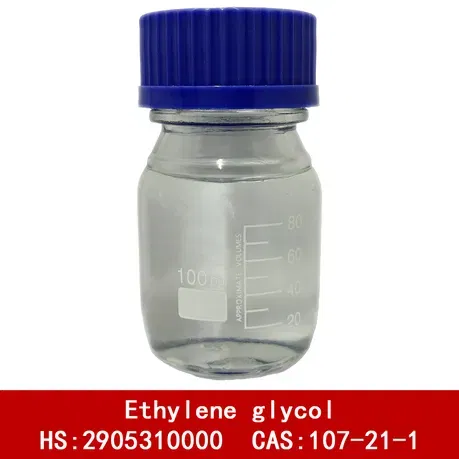

MEG heat transfer fluid is the fluid that carries heat between a chiller, a process load, or a solar collector and the place where that heat is rejected or used. Ethylene glycol (MEG, CAS 107-21-1) does this work in chilled-water loops, data center cooling units, cold-storage brines, and closed-loop solar systems because it lowers the freezing point without the viscosity penalty of propylene glycol. MEG suits all of them. What takes design work is the concentration, the inhibitor package, and how much pump and heat exchanger margin the loop needs.
Key Takeaways
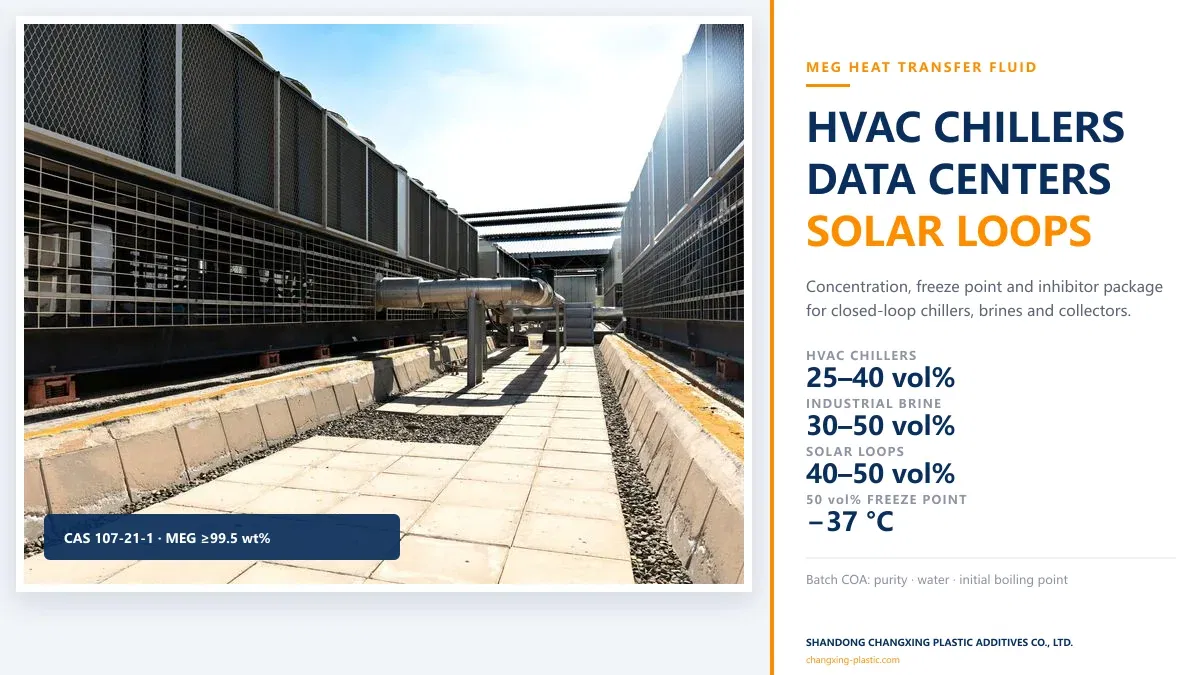
- ✅ HVAC chillers usually run 25–40 vol% MEG; industrial brines run 30–50 vol%; closed solar loops run 40–50 vol%
- ✅ Freeze point is where ice starts forming, not where pipes burst. Design to the lowest expected ambient temperature minus 3–5 °C
- ✅ At 20 °C, 30 vol% MEG has about 0.45 W/m·K thermal conductivity and 3.65 kJ/kg·K specific heat, against 0.60 and 4.18 for water
- ✅ MEG has roughly 10–15% higher thermal conductivity than propylene glycol at the same concentration, but it is toxic if ingested
- ✅ The inhibitor package and annual testing decide whether the fluid lasts 5–10 years or fails in two
Where MEG Heat Transfer Fluid Fits
MEG heat transfer fluid fits any secondary loop that must stay liquid below 0 °C: HVAC chilled water, data center cooling, industrial process brine, cold storage, and closed solar thermal. It is there for freeze protection; where water can be used, water remains the better heat carrier.
Most cooling systems use two loops. Refrigerant does the phase change in the chiller; a secondary fluid carries the cooling or heating duty to the load. Water is the best secondary fluid on every thermal measure: high conductivity, high specific heat, low viscosity, low cost. It also freezes at 0 °C and expands when it does, which is unacceptable for outdoor piping, winter standby, and equipment that may lose power in a cold snap.
MEG closes that gap. A 30 vol% blend protects to about −14 °C, a 40 vol% blend to about −24 °C, and a 50 vol% blend to about −37 °C. Those numbers cover most of Europe, North China, and inland North America without moving to a more viscous glycol. The trade-off is thermal: glycol mixtures conduct less heat, hold less heat per kilogram, and resist flow more than water, so the loop's pumps and heat exchangers must be sized for the brine rather than for water.
Purity matters more than most buyers expect. A specification-grade MEG at ≥99.5 wt% with water at ≤1.0% gives a predictable freeze curve. Water already in the drum shifts the concentration, and a blend made by volume from undosed glycol will not match the supplier's chart. For HVAC and process loops, MEG heat transfer fluid is usually purchased as a pre-mixed inhibited blend, not as raw MEG poured into a tank on site. See our MEG coolant guide for the difference between industrial inhibited glycol and automotive coolant.
MEG vs Water vs Propylene Glycol
Ranked on heat transfer, water comes first, MEG second, and propylene glycol third. On ingestion risk, PG is far safer than MEG, which is why PG appears wherever a leak could reach food or drinking water.
Propylene glycol (PG) is the usual alternative when a leak could reach food, drinking water, or the public. It is far less toxic, but it is a poorer heat transfer fluid. At the same concentration, PG has roughly 10–15% lower thermal conductivity and higher viscosity, especially below −10 °C. That means larger coils, higher flow, or more pump power to move the same duty.
| Property (typical, 30 vol%, 20 °C) | Water | MEG | PG |
|---|---|---|---|
| Thermal conductivity (W/m·K) | 0.60 | ~0.45 | ~0.40 |
| Specific heat (kJ/kg·K) | 4.18 | ~3.65 | ~3.75 |
| Viscosity at 20 °C (cP) | ~1 | ~7.5 | ~10 |
| Freeze point (°C) | 0 | −14 | −12 |
| Oral LD50, rat (mg/kg) | Nontoxic | ~4,700 | ~20,000 |
Two numbers carry most of the comparison. At 30 vol% and 20 °C, MEG freezes at −14 °C against −12 °C for PG, and the oral LD50 in rats is about 4,700 mg/kg for MEG against about 20,000 mg/kg for PG.
The table is a starting point, not a design table. Glycol properties change with concentration and temperature, and inhibitor packages vary by supplier. Pump curves, control valves, and heat exchanger surfaces should be selected from the brine manufacturer's data at the actual operating temperature, not from water-based assumptions.
How to Pick the MEG Concentration
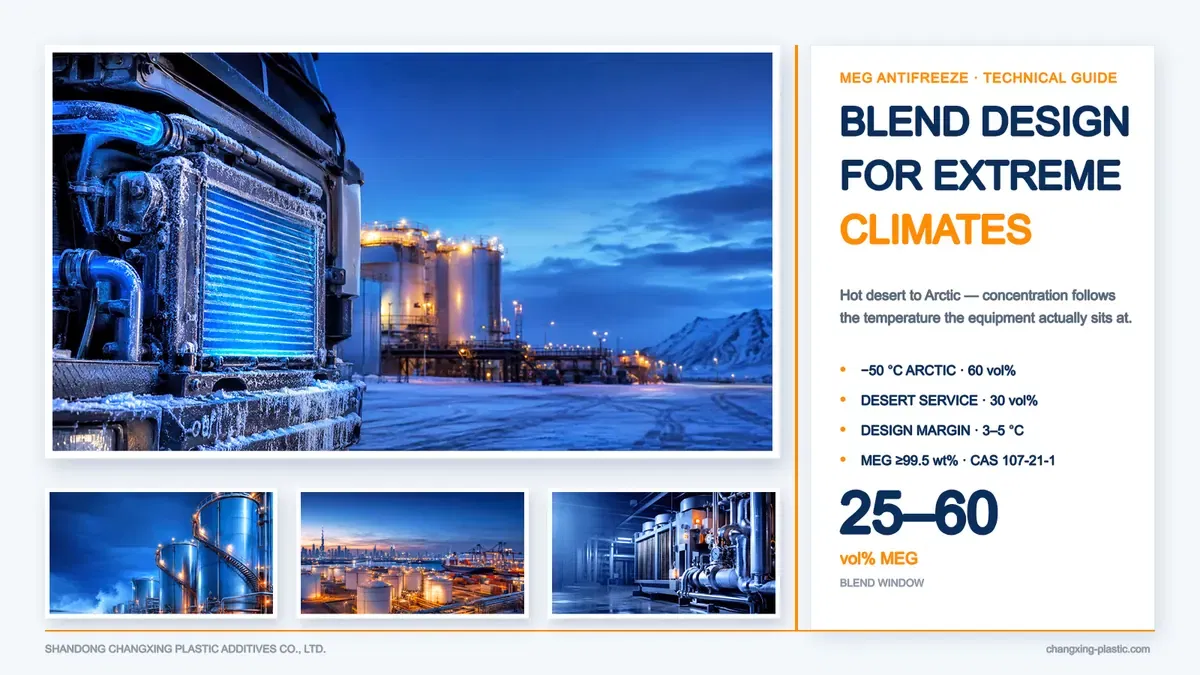
Start with the lowest temperature the fluid will see while the loop is idle, not the normal operating temperature. Outdoor dry coolers, rooftop piping, and solar collectors all sit below ambient at night. Subtract 3–5 °C for sensor error, stratification, and a cold snap beyond the design year, then read the concentration from a freeze-point table. On the curve used here, 25 vol% freezes at −10 °C, 40 vol% at −24 °C, and 60 vol% at −52 °C.
| MEG concentration (vol%) | Freeze point (°C) | Typical use |
|---|---|---|
| 20 | −8 | Indoor chilled water with burst protection only |
| 25 | −10 | Mild-climate HVAC loops |
| 30 | −14 | Data center dry coolers, indoor/outdoor chillers |
| 35 | −19 | Cold-climate HVAC, process cooling |
| 40 | −24 | Rooftop piping, industrial brine |
| 50 | −37 | Cold storage, solar loops in severe climates |
| 60 | −52 | Arctic service; diminishing returns above this point |
Concentration is not a safety dial. Above roughly 60 vol%, the freeze point starts to rise again and pure MEG freezes at −12.9 °C. Viscosity and pump power climb faster than freeze protection improves, and heat transfer gets worse. A 50 vol% blend where 35 vol% would do adds glycol inventory and pumping cost for no operating benefit. The design case for extreme climates, including the 60 vol% ceiling, is covered in our MEG antifreeze blend design guide.
Ethylene Glycol HVAC: Chiller and Data Center Loops
Commercial chilled-water systems run MEG heat transfer fluid at 25–40 vol%. The low end is common where only indoor piping needs burst protection; the high end appears when rooftop air handlers, outdoor dry coolers, or unheated mechanical rooms are in the loop. A 40 vol% blend protects to about −24 °C, which covers most of northern Europe and northern China with margin.
Data centers are the fastest-growing user of ethylene glycol HVAC loops. High-density halls use glycol-cooled chillers and outdoor fluid coolers that run all winter to capture free cooling. A 30–35 vol% blend protects to −15 to −20 °C while keeping heat capacity high enough for dense loads. The dry cooler and plate heat exchanger must be selected on glycol properties. The inhibitor must be compatible with copper and aluminum, because a fouled close-finned coil is expensive to clean.
Pump sizing is where water-based assumptions fail. A 30 vol% MEG blend at 20 °C is roughly seven times as viscous as water, and the gap widens as the fluid cools. Flow rates rise to carry the same heat, and pressure drop rises faster. Designers who size the loop on water and then add glycol often end up with a chiller that cannot reach its rated capacity on the coldest nights.
MEG Brine in Industrial Process Cooling and Cold Storage
Industrial process cooling uses MEG brine at 30–50 vol% to carry cooling from a central chiller to reactors, extruders, fermentation tanks, and cold-storage rooms. The brine loop may run at −10 to −30 °C, well below the freeze point of water. MEG is preferred over calcium chloride brine because an inhibited MEG loop is compatible with carbon steel and copper-brazed plate heat exchangers; CaCl₂ brine is corrosive enough to require titanium or PTFE wetted parts in many designs.
Food plants need a different arrangement. Where incidental food contact is possible, the secondary fluid must be PG, not MEG. The common solution is a two-loop system: MEG in the primary chiller loop, PG in the food-contact secondary. That keeps the thermal performance of MEG in the larger circuit and confines the higher-cost, lower-toxicity fluid to the part of the plant where a leak would matter.
MEG Solar Thermal and Heat Pump Loops
Closed-loop MEG solar thermal systems in freezing climates use 40–50 vol% glycol. The collector loop is sealed, so toxicity is less of an issue than in an open loop, and the concentration is set by the coldest night the collectors will see. MEG is common in large industrial and district-heating arrays; PG is often specified for residential systems and anywhere a leak could reach a roof drain, garden, or groundwater.
The solar-specific risk is stagnation. When a pump stops on a sunny day, the collector can sit well above 150 °C. At that temperature, with oxygen present, glycol oxidises into glycolic and oxalic acid. The fluid darkens, pH falls, and the acids attack copper and brass. A loop that is fine in normal operation can destroy its fluid in a few stagnation events. Specify a fluid rated for the collector's stagnation temperature, use a controller that cools or drains the loop, and test pH after any extended stagnation.
Drainback systems avoid the problem entirely: the collectors empty when the pump stops, so water can be used. Pressurised closed loops cannot drain, which is why the glycol specification, the inhibitor package, and the stagnation strategy have to be designed together.
Inhibitors, Materials and Fluid Life
Fluid life is set by the inhibitor package, not by the glycol. With clean water and an intact OAT or HOAT package, a closed loop usually runs 5–10 years; once the inhibitor is spent, corrosion begins even though the glycol is still in the pipe.
MEG alone is not a finished heat transfer fluid. It needs a corrosion inhibitor package, a pH buffer, and usually a dye and antifoam. OAT (organic acid technology) and HOAT (hybrid OAT) packages are common in HVAC and industrial loops because they protect copper, brass, steel, and aluminium without the silicate drop-out that fouls tight heat exchangers. Solar loops need a package rated for higher temperatures and for copper, with a borate or phosphate buffer to neutralise the acids formed during stagnation.
Materials matter as much as chemistry. Carbon steel, stainless steel, copper, brass, and most EPDM and PTFE seals are compatible with properly inhibited MEG. Galvanised steel and some zinc-rich coatings are not. Aluminium needs a package formulated for it. Never mix inhibitor chemistries from two suppliers, and top up with the same premix rather than raw glycol and water; a top-up changes both concentration and inhibitor reserve.
Test concentration every season and test pH, reserve alkalinity, and inhibitor level annually after year 5. Replace the fluid when pH falls below the supplier's minimum, when inhibitor reserve is exhausted, or when the fluid is visibly contaminated. A $200 lab test is cheaper than a corroded plate heat exchanger.
MEG Heat Transfer Fluid Specification Checklist
- Base glycol: MEG ≥99.5 wt%, water ≤1.0%, initial boiling point ≥185 °C, CAS 107-21-1.
- Concentration and freeze point: state both, plus the design ambient temperature and the 3–5 °C margin.
- Inhibitor package: name the chemistry (OAT/HOAT), list compatible metals and elastomers, and give the pH range.
- Water quality: use deionised or softened water for premix; chloride and hardness limits should come from the inhibitor supplier.
- Documentation: batch COA covering purity, water, and boiling point; SDS; packaging and shelf-life data.
- Commissioning: flush the loop, fill with premix, label the concentration, and record the fill date and batch.
Shandong Changxing Plastic Additives Co., Ltd. supplies specification-grade MEG at ≥99.5 wt% with batch COA data for purity, water content, and initial boiling point, in drums, IBCs, and ISO tanks. For buyers comparing virgin and reclaimed material, our recycled MEG cost analysis covers where reclaimed glycol fits and where it does not.
Frequently Asked Questions
Q1: Can I use automotive antifreeze as an HVAC heat transfer fluid?
No. Automotive coolant is formulated for an engine's aluminium and cast-iron internals, often with silicate or phosphate chemistry and a dye load that is unnecessary in a building loop. Use an industrial inhibited glycol matched to the loop's metals and operating temperature, and check the inhibitor's compatibility with the plate heat exchanger before filling.
Q2: What MEG concentration gives protection to −20 °C?
About 35 vol% MEG freezes near −19 °C, so use 35–40 vol% for a −20 °C design with a small margin. Do not design to the freeze point alone if the loop can sit idle: the burst point is lower, and a slush-filled coil can still be damaged by expansion.
Q3: Should I use MEG or PG in a solar thermal loop?
Both are used. MEG is common in large closed industrial arrays where thermal performance and cost matter; PG is often specified for residential systems and anywhere a leak could reach people, food, or groundwater. Whichever you choose, confirm the fluid's maximum use temperature against the collector's stagnation temperature.
Q4: Can MEG be used in a food processing plant?
Not in a loop where the fluid could contact food. Use PG for the food-contact secondary. MEG is acceptable in the primary chiller loop of a two-loop system, where the two fluids exchange heat through a double-wall or monitored heat exchanger and never mix.
Q5: How often should MEG heat transfer fluid be tested?
Check concentration with a refractometer every season and after any top-up. From year 5, test pH, reserve alkalinity, and inhibitor level annually. Replace the fluid when pH is below the supplier's limit, inhibitor reserve is gone, or the sample carries sediment or a strong odour.
Need MEG for a heat transfer loop?
Shandong Changxing Plastic Additives Co., Ltd. supplies specification-grade ethylene glycol at ≥99.5 wt% with batch COA data for purity, water content, and initial boiling point. Tell us the loop, the design low temperature, and the metals involved, and we will quote the glycol grade and documentation you need.
Request a Free Quote + Technical Data Sheet- ✓ MEG ≥99.5 wt%, CAS 107-21-1, water ≤1.0%
- ✓ Batch COA: purity, water content, initial boiling point
- ✓ IMS-certified: ISO 9001 / 14001 / 45001 / 50001
- ✓ Drums, IBCs, and ISO tanks for industrial volumes
- ✓ Export documentation for buyers outside China