
Plate-out in PVC extrusion is the name processors give the material that leaves a compound and settles on metal: die lips, calibrators, cooling rolls, screw flights, screen packs. Die build-up is the same event seen at the die. The line runs clean for a few hours, then a ring appears at the lip, the surface picks up die lines or matte streaks, and someone reaches for a brass scraper.
Short answer: the deposit is almost always a mixture, and the plasticizer is one candidate among several. Identify what the deposit is made of before changing the formula. Then check six inputs in a fixed order: resin fusion, filler, stabilizer and lubricant, pigment, plasticizer, and the die and process. Time-to-failure, not opinion, decides whether a change worked.
This article is written from the additive side. Shandong Changxing supplies DOTP (CAS 6422-86-2) to cable compound, film and sheet, profile and synthetic leather plants. The process points below are general extrusion practice; the plasticizer rows are ours, and we say plainly where a plasticizer change cannot fix plate-out.
What plate-out and die build-up are
Plate-out is a deposit on equipment. Die build-up is that deposit at the die. In polyolefin extrusion the same behaviour is often called die drool; in PVC the older plant word is plate-out, and it covers every metal surface the melt touches.
Where it lands depends on the product. A film and sheet line usually shows it at the die lip and on the first cooling roll. A cable line finds it at the die and inside the calibrator. Profiles pick it up at the die and the sizing sleeve. Calendered synthetic leather can carry it on the rolls, where it shows as haze or a repeating mark.
The symptoms on the product are always the same: die lines, matte patches, loss of gloss, a rough hand, weld-line marks that were not there before, or a sudden change in dimensional pull. None of these tells you the cause. The deposit itself does.
How to read a plate-out deposit before you change the formula
The deposit narrows the list of possible inputs, so read it before you touch the formula. Scrape a sample with a clean brass tool onto aluminium foil, note the position, the running hours and the die temperature at the time, then look at it.
| What you see | What it usually points to | First check |
|---|---|---|
| Waxy, greasy, soft | External lubricant, plasticizer-rich exudate | Lubricant balance and plasticizer loading |
| White, chalky, powdery | Calcium carbonate, calcium stearate, titanium dioxide | Filler coating and stabilizer package |
| Sticky, tacky | Plasticizer that the compound has not absorbed | Fusion level and mixing sequence |
| Brown or black crust | Degradation products, metal soaps, pigment | Melt temperature and residence time |
Appearance narrows the field of plate-out sources; it does not close it. FTIR identifies the organic part of the deposit. EDS or XRF gives the element pattern: calcium points to filler or calcium stearate, titanium to pigment, and zinc to a Ca/Zn stabilizer. TGA tells you how much of the sample is volatile. A plant that sends one deposit sample for this analysis usually saves more time than it spends.
One caution on sampling. A scraper blade is also a source of metal. Use brass or a plastic tool on the die lip, and never scrape a chrome-plated surface with steel.
Six inputs that feed plate-out
Most plate-out investigations end with two contributors, not one. Work through the list in this order and you start to see how they interact.
| Input | What it contributes | First check |
|---|---|---|
| Resin and fusion | Under-fused compound leaves plasticizer unabsorbed; over-sheared compound degrades | Fusion level, melt temperature, output against rated rate |
| Filler | Stearate coating releases free stearic acid; moisture flashes at the die | Coating type and level, moisture, lot change |
| Stabilizer and lubricant | Calcium stearate and excess external wax migrate to the wall | Internal and external lubricant balance |
| Pigment | High oil-absorption grades hold volatiles and release them late | Pigment grade, dispersion, lot change |
| Plasticizer | Migration, over-loading, acidity, moisture, poor absorption | Loading, acid value, moisture, colour, mixing |
| Die and process | Cold wall, long residence, high shear, worn or poorly cleaned land | Temperature profile, residence time, die condition |
The table is not a ranking of plate-out risk. In a plant that has just changed filler supplier, filler is the first suspect. In a plant that has run the same formula for a year and changed nothing, the die temperature or a worn screw is more likely than the recipe.
Why the deposit lands on the die
Molten PVC is viscoelastic, and it flows through the die in layers. The layer against the wall moves slowly; the core moves fast. Low-surface-energy species such as lubricants, stearates and plasticizer drift toward the slow layer under shear. That migration is normal. Plate-out begins when the wall can no longer hold them in solution.
Two conditions push the wall past that point. The first is temperature: die lips and adapters often run cooler than the melt, and solubility falls as the metal cools. The second is concentration: an over-loaded or under-fused compound carries more free plasticizer than the resin can keep. Volatiles condense on the same cool metal, and degradation products react with metal soaps to form chlorides that stick and darken.
This is why plate-out takes hours to show. The first layers are thin enough that they do not disturb the flow. Once the deposit reaches a critical thickness, it alters the flow boundary, and the defect appears all at once. It is also why cleaning alone brings temporary relief: the surface is clean, but the conditions that caused the deposit are unchanged.
A seven-step field check order for plate-out
The order below moves from cheap evidence to expensive changes, one variable at a time, and it is written for a line that is running. The first three steps need only a scraper, a sample bag and a contact probe.
1. Define the failure in numbers
Write down the defect, its position, the running hours before it appears, and whether it clears after purging. "Plate-out" is a category; "a matte band at the die lip after four hours, cleared by purging, returns at the same position" is a case you can test.
2. Take the deposit sample
Sample the die lip and, separately, the calibrator or first roll. If the two deposits differ, you are probably looking at two mechanisms, not one.
3. Verify the temperature profile
Measure the die lip, adapter and melt with a contact probe. Controller readings and real metal temperature are not always the same, especially on an older die with a failing cartridge. A die running below the rest of the line is a classic build-up site.
4. Check residence time and output
Running well below rated output lengthens residence time; running above it raises shear. Both change how much low-molecular material reaches the wall, and so how fast plate-out builds. Compare the current rate with the rate at the last clean run.
5. Check incoming lots against the COA
Filler coating, stabilizer lot, pigment lot and plasticizer lot. A supplier change that looks minor on paper can move the deposit. Keep the certificates next to the trial record.
6. Bisect the formula, one variable at a time
On a lab compounder or a small line, reduce or remove one component per run and stop when the deposit disappears. Start with external lubricant, then filler coating, then pigment, then plasticizer lot. Changing two variables at once gives you a result you cannot explain.
7. Clean, re-baseline, and record time-to-failure
Clean the die properly, photograph the lip, and run the baseline again. Record the hours to the same defect. That number is the only fair comparison for the next change.
What the plasticizer does, and what it does not
Plasticizer is a low-molecular, low-surface-energy component. It can migrate to the wall like any other plate-out source, and the risk rises when the compound cannot hold it. Three things decide whether your plasticizer is part of the problem.
Solvating power and fusion
DOTP is a slightly less solvating plasticizer than DOP for PVC. Most compounds need a few phr more, or a little more heat and work, to reach the same hardness. Run a DOTP compound on the old DOP temperature profile and the result can be under-fused: plasticizer sits free in the melt instead of being absorbed, and free plasticizer is exactly what migrates. The compounding side is covered in the wire and cable application guide and the PVC film guide.
Purity rows that matter here
Three delivery rows are worth reading when plate-out is the complaint.
- Acid value at ≤0.035 mg KOH/g limits acidic species that can attack the stabilizer system and the metal.
- Moisture at ≤0.1% limits flashing at the die.
- Ester content at ≥98% limits the residual alcohol and monoester that volatilise and condense on cool metal.
Our DOTP is specified on all three, and the full row set sits in the technical properties guide.
Loading and absorption
More plasticizer is not more safety margin. Past the point the compound can hold at that temperature, the excess behaves like a free liquid. Set loading from the hardness and cold-flex target, then confirm that the dry blend absorbs it before the compound reaches the die.
The limits matter as much. A new plasticizer will not fix a die that runs cold, a filler carrying excess stearate, or an over-lubricated formula. If the deposit is white and chalky, swapping the lot changes nothing. Change the plasticizer only when the plate-out evidence points there.
Choosing a DOTP grade when appearance matters
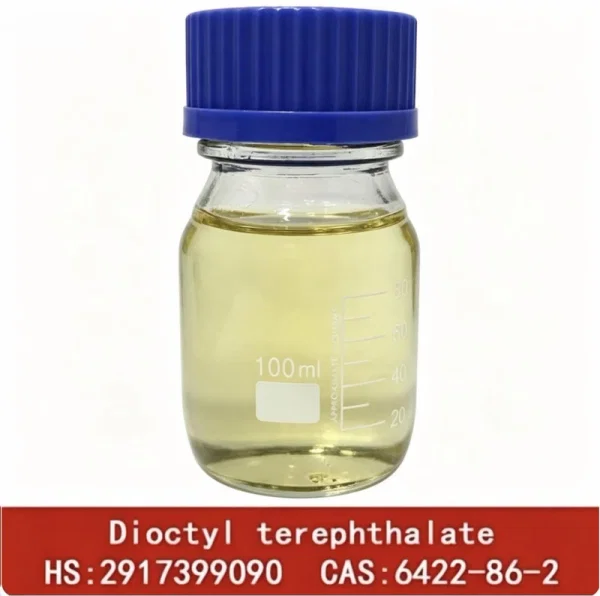
When plate-out puts the plasticizer under review, grade selection comes up at the same time. Colour ceiling is the row this decision turns on: 150 APHA, 230 APHA or 450 APHA.
| Grade | Colour ceiling | Where it fits |
|---|---|---|
| Superior | 150 APHA | Transparent, pale or colour-critical parts |
| First-grade | 230 APHA | General PVC compounds with a normal colour standard |
| Qualified | 450 APHA | Black and dark compounds where pigment hides the tint |
Grade is a colour-ceiling decision, not a plate-out rating. A lower colour ceiling does not make the plasticizer less likely to migrate. A dark compound on qualified grade and a pale one on superior grade can plate out the same way if the die is cold or the formula is over-lubricated.

Superior
150 APHA ceiling
First-grade
230 APHA ceiling

Qualified
450 APHA ceiling
How to run a trial that proves the change
A plate-out trial only answers the question if everything except the variable stays the same. Use the same resin lot, filler lot, stabilizer package and die. Change one thing: the plasticizer lot, the loading, or the lubricant level.
Run until the same defect appears, or until the baseline time-to-failure has passed with no deposit. Photograph the die lip at fixed intervals under the same light. Weigh nothing unless you have a repeatable method; a visual rating and an hours count are more useful than a number nobody trusts.
Repeat the run. A single result can come from a die that was cleaned differently or a room that was warmer. The second run is what tells you whether the first one meant anything.
Frequently asked questions
Is plate-out in PVC extrusion caused by the plasticizer?
Sometimes, but rarely on its own. Plasticizer is one of several low-surface-energy ingredients that can migrate to the die wall. External lubricants, stearate-coated filler, calcium stearate in the stabilizer package, high-oil-absorption pigment and a cold die all produce the same symptom. Identify the deposit before you change the plasticizer.
What does die build-up look like on a PVC line?
A ring or patch of deposit at the die lip, often chalky, waxy or crusty. On the product it shows as die lines, matte streaks, loss of gloss, roughness or a sudden change in surface hand. It usually appears after hours of running, not at start-up.
Why does plate-out appear after several hours instead of immediately?
The deposit has to reach a critical thickness before it changes the flow at the die wall. Migration and condensation are slow, and the first layers sit inside the surface roughness. That delay is useful: time-to-failure is the most reliable number to track when you test a change.
Can switching to DOTP stop plate-out?
Only when the plasticizer is part of the cause: an under-fused compound, a plasticizer loading above what the compound can hold, or a lot with high acidity or moisture. DOTP does not repair a cold die, an over-lubricated formula or a filler carrying excess stearate. Change one variable at a time and measure time-to-failure.
How do I identify what the deposit is made of?
Start with colour and feel, then confirm with analysis. FTIR identifies the organic part; EDS or XRF gives the element pattern, so calcium points to filler or calcium stearate, titanium to pigment, and zinc to the stabilizer. A brown or black crust usually means degradation products are involved as well.
Which DOTP grade should a dark PVC compound use?
Qualified grade, with a colour ceiling of 450 APHA, is the usual fit when carbon black or a dark pigment hides the plasticizer's tint. Pale or transparent parts move to first-grade at 230 APHA or superior at 150 APHA. Grade is an appearance decision; it is not a rating for plate-out resistance.
Stuck on a deposit you cannot identify?
Shandong Changxing Plastic Additives Co., Ltd. supplies DOTP in superior, first-grade and qualified grades, reaches 230,000 tonnes a year in group plasticizer capacity upon full completion, and holds ISO 9001 / 14001 / 45001 / 50001 certification. Send us the plate-out description, the compound and the die conditions; we will tell you whether the plasticizer is worth testing, and quote the grade and batch COA you need.
Request a quote and batch COA- ✓ Superior 150 APHA, first-grade 230 APHA, qualified 450 APHA
- ✓ Ester content ≥98%, acid value ≤0.035 mg KOH/g, moisture ≤0.1%
- ✓ CAS 6422-86-2, HS 2917399090; ISO 9001 / 14001 / 45001 / 50001 certified
- ✓ 230,000 tonnes of annual plasticizer capacity upon full completion
- ✓ SGS reports on file: phthalates not detected, EN 71-3 element migration, PFAS total fluorine screening