
Toy shipments rarely fail EN 71-3 because of the formulation. They fail on paperwork: a supplier sends a test report with no standard version, no material category and no test method, or the buyer asks about phthalate content and gets an answer about the migration of 19 elements. Mix the two rules up and a compliant sample still gets rejected.
This guide separates the two. EN 71-3 measures how much of 19 elements migrates out of a toy material. The phthalate limits in the EU, the US and China measure how much of certain ortho-phthalates the material contains. A non-phthalate plasticizer settles the second question; the first still depends on a test report for the finished compound. Below are the selection table, the supplier document set, and our DOTP results from SGS that you can check line by line.
EN 71-3 and phthalate limits test different things
EN 71-3 is a migration test: the material goes into a simulated gastric fluid and the lab measures how much of each element leaches out. A phthalate limit is a content test: the material is dissolved and the lab measures how much of the restricted substance is present. One result is reported in mg/kg, the other as a percentage by mass. Treating them as one document is the most common reason a toy factory loses points on a buyer questionnaire.
| Item | EN 71-3 | Phthalate limits (REACH Annex XVII, CPSIA, GB 6675.1) |
|---|---|---|
| What is measured | Migration of 19 elements in simulated gastric fluid | Content of specified phthalates in the material |
| Unit | mg/kg | % by mass |
| Legal basis | Harmonised standard under the EU toy safety framework | REACH Annex XVII entries 51 and 52, 16 CFR 1307, GB 6675.1 |
| A report can prove | The material's contribution to element migration | Whether the material contains restricted phthalates |
| It cannot prove | Phthalate content | That element migration passes |
Handing a buyer a report that says "19 elements not detected" in answer to a phthalate questionnaire answers the wrong question. Screening only for phthalates leaves lead, cadmium and mercury migration unproven. The file is incomplete without both reports.
Category III: soft PVC toys are tested at the tightest exposure
EN 71-3 sorts toy materials by how a child takes them in. Category III covers scraped-off material, at an assumed intake of 8 mg per day, and soft PVC toys, surface coatings and printing inks all sit in Category III. Category I covers dry, brittle, powdery or pliable materials such as chalk and crayons, at 100 mg. Category II covers liquid or sticky materials such as finger paints and bubble solution, at 400 mg.
The test covers 19 elements: aluminium, antimony, arsenic, barium, boron, cadmium, chromium(III), chromium(VI), cobalt, copper, lead, manganese, mercury, nickel, selenium, strontium, tin, organic tin and zinc. Labs normally run ICP-OES for the metals, IC-UV for hexavalent chromium and LC-ICP-MS for organic tin speciation. The Category III limit for chromium(VI) has been 0.053 mg/kg since 2019, the tightest entry in the table.
The current edition is EN 71-3:2019+A2:2024, approved by CEN on 31 October 2024 and published on 4 December 2024. A2 revised several migration limits, so a report has to state which edition it used. A report that says only "EN 71-3" will come back in a brand audit.
"ND" on a report means below the method detection limit, not zero. Detection limits vary by element and instrument, usually between 0.01 and 1 mg/kg, and the actual figures sit in the report annex. If a buyer asks for "zero migration", put the detection limit and the retest rule into the acceptance clause, or the two sides will read the same ND differently.
Phthalate limits in three markets (2026 edition)
Three separate regimes apply: REACH Annex XVII in the EU, 16 CFR 1307 in the US and GB 6675.1 in China, and all three moved in 2026. Confirm the version in force in the destination market before shipping; a report from three years ago will not carry.
EU: REACH Annex XVII and the new Toy Safety Regulation
REACH Annex XVII entry 51 restricts DEHP, DBP, BBP and DIBP to below 0.1% in articles. The limit applies to the plasticised material inside the article, not to the average of the whole toy, so each PVC component in a multi-material toy has to comply on its own. Entry 52 sets separate limits for DINP, DIDP and DNOP in toys and childcare articles that can be placed in the mouth.
The Toy Safety Regulation (EU) 2025/2509 entered into force on 1 January 2026 and replaces Directive 2009/48/EC in full from 1 August 2030; the directive stays in force during the transition. The regulation tightens chemical safety, introduces the digital product passport and extends rules to online sales, so EU-facing factories should align formulation upgrades and documentation with that timetable.
US: CPSIA 16 CFR 1307
CPSIA, codified at 16 CFR 1307, permanently bans more than 0.1% of eight phthalates in children's toys and child care articles: DEHP, DBP, BBP, DINP, DIBP, DPENP, DHEXP and DCHP. Children's products also need a CPC certificate based on third-party laboratory testing, supplied with the shipment to the importer. This is a content test run to CPSC-CH-C1001-09.4, not a migration test.
China: GB 6675.1 moves from 2014 to 2025
GB 6675.1-2014, clause 5.3.7, limits six phthalates (DEHP, DBP, BBP, DINP, DIDP, DNOP) to 0.1%. The matching test method is GB/T 22048-2022, effective 1 August 2023, with Amendment No. 1 taking effect on 1 November 2026. GB 6675.1-2025 was published on 5 October 2025 and takes effect on 1 November 2026, raising the list from six phthalates to ten by adding DIBP, DPENP, DHEXP and DCHP. Product made to the old standard may be sold until 1 November 2027.
Toys intended to contact food, and children's tableware, also fall under GB 31604.30-2025, effective 16 September 2025, which covers the determination and migration testing of 19 phthalates. One standard is often misquoted: GB 24613-2009 is the limits standard for toy coatings, not a plasticizer limit, and it has been replaced by GB 30981.2-2025, effective 1 June 2026.
DOTP, ATBC or DINCH: choosing for a toy compound
Three non-phthalate plasticizers dominate toy-grade soft PVC: DOTP, ATBC and DINCH. Check the regulatory boundary first, then process fit, then landed cost. Reversing that order is how projects end up re-formulating twice.
| Item | DOTP | ATBC | DINCH |
|---|---|---|---|
| Chemical class | Terephthalate (para) | Acetyl citrate | Cyclohexanedicarboxylate |
| Restricted phthalate? | No (not an ortho-phthalate) | No | No |
| Typical load at equal hardness | Close to DOP, usually 2-5 phr more | Higher | Close to DOP |
| Migration and extraction resistance | Good | Moderate | Good |
| Cost vs DOTP | 1.0 (baseline) | About 2x or more, market-dependent | About 2x or more, market-dependent |
| Supply | Large domestic capacity, stable lead times | Small to mid-scale | Concentrated supplier base |
| Typical use | Dolls, inflatables, play mats, bath toys and other general soft PVC | Teethers, pacifiers and other mouth-contact parts | Premium lines or products marketed as medical-grade |
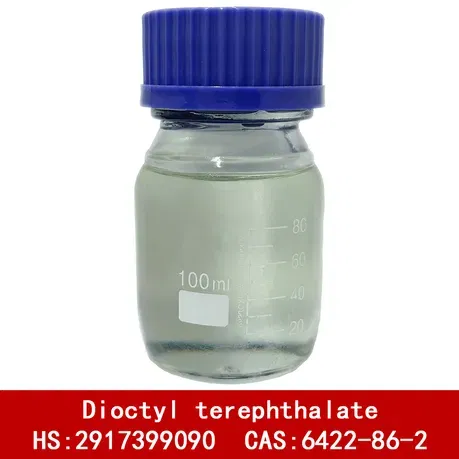
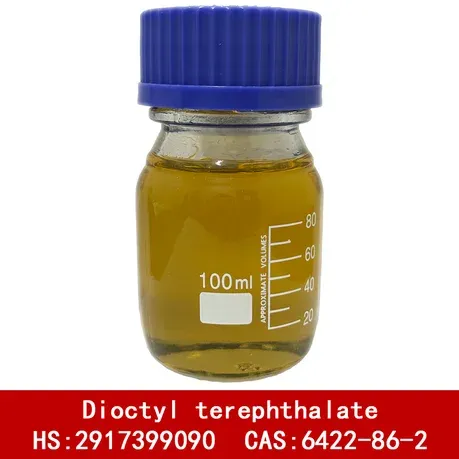
DOTP is dioctyl terephthalate, a terephthalate rather than an ortho-phthalate, so it is outside REACH entries 51 and 52, CPSIA 16 CFR 1307 and the GB 6675.1 restricted list. "Phthalate-free" in the trade means free of those restricted ortho-phthalates. Write that qualification into the formulation sheet and the customer declaration, or a technically minded buyer will ask about the structure. For the replacement mechanics, see our guide to DOTP as a DEHP alternative.
For volume production, DOTP gives the best cost-performance balance and the simplest process switch. ATBC is a bio-based citrate used in mouth-contact parts; DINCH resists migration well and suits premium positioning. Both usually cost more than twice as much as DOTP, so the premium only makes sense for mouth-contact parts, a brand that requires bio-based content, or a buyer specification. For a wider comparison of plasticizer classes, see the phthalate-free plasticizer guide.
What a supplier document set should contain
A supplier document set needs five items: a third-party test report, a COA matched to the batch number, an SDS, a REACH statement and management system certificates. A missing one will stop a brand audit or a port inspection, because an audit compares each report with the batch on the truck.
- Test report: issued by SGS, TÜV or another third party, stating the standard edition (for example EN 71-3:2019+A2:2024), the material category (Category III), the test method, all 19 results and the detection limits. The issuing lab should hold ISO/IEC 17025 accreditation.
- COA: matched to the shipment batch number, with ester content, acid value, colour and water.
- SDS: GHS classification and CAS number (6422-86-2 for DOTP) consistent with the sample name on the report.
- REACH statement: confirming whether the substance appears on the SVHC list or in Annex XVII.
- Management system certificates: ISO 9001 at minimum; EU and US brand customers usually also ask for 14001 and 45001.
Two points get overlooked. A plasticizer's EN 71-3 report covers that one component; the resin, stabilizer (barium-zinc or calcium-zinc), filler and pigment in the finished compound still need to be tested together. And ND means below the detection limit, not zero, so the purchase contract should fix the detection limit and the retest rule.
Our DOTP test data
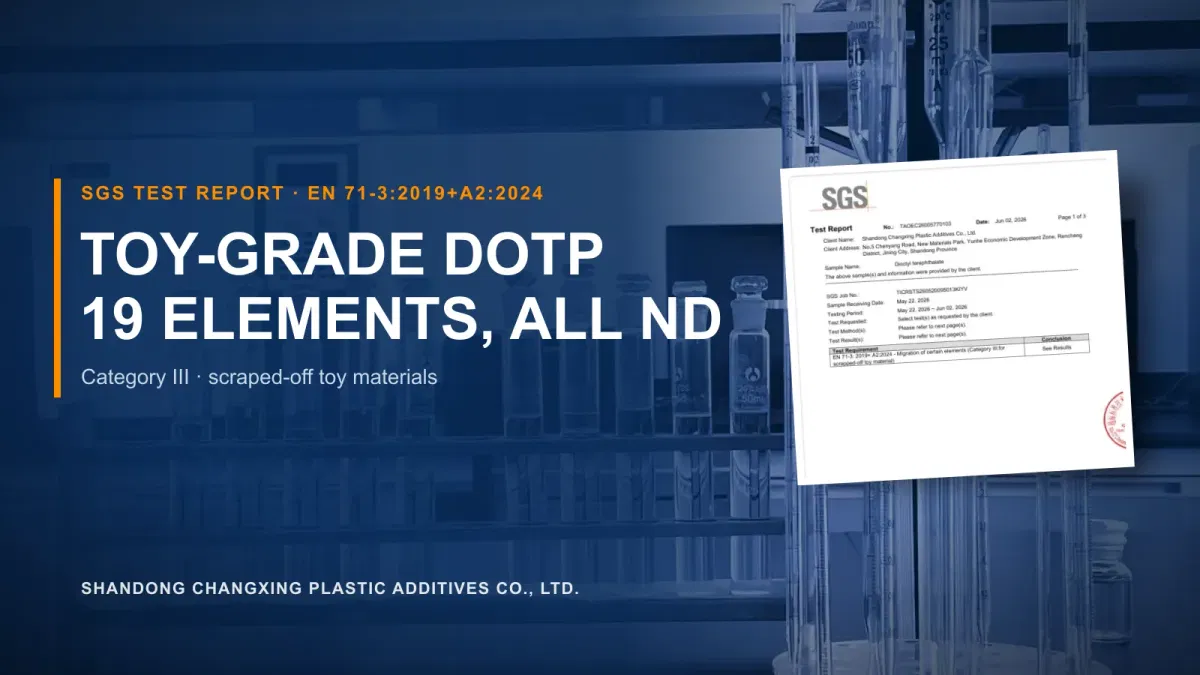
Shandong Changxing Plastic Additives sent its DOTP to SGS-CSTC for EN 71-3:2019+A2:2024 Category III testing. Report No. TACEC26005770103, work No. TICRSTS260520095013KIYV, dated 2 June 2026: all 19 elements were not detected. The same round covered phthalates and PFAS:
| Test | Standard or method | Result |
|---|---|---|
| Element migration | EN 71-3:2019+A2:2024, Category III | 19 elements ND |
| Phthalates | CPSC-CH-C1001-09.4, 17 substances | All ND |
| PFAS, total fluorine | EN 14582:2016 | ND, below 20 mg/kg |
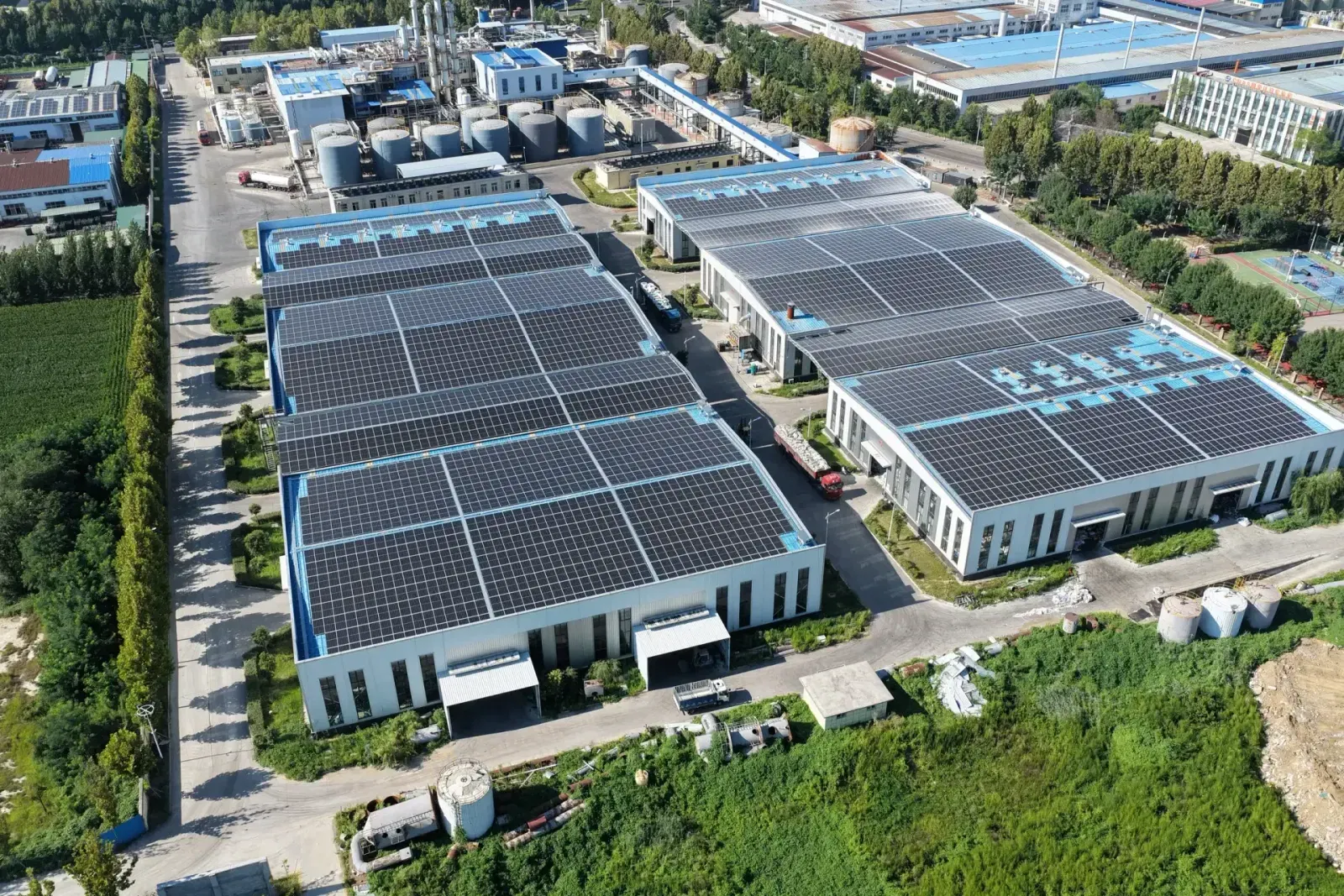
Those three reports, ISO 9001/14001/45001/50001 certification and 230,000 tonnes of annual plasticizer capacity are the three kinds of evidence a toy factory can pull during a supplier audit. The submission details behind the tests are in our SGS three-test record; the wider regulatory direction is covered in our global phthalate ban analysis.
Switching a compound from ortho-phthalates to DOTP
Switch a compound in five steps, in this order: map the compounds, run a lab trial, test the finished compound, build batch traceability and lock in supply. The plasticizer swap itself is one line in the recipe; the formulation, process and paperwork have to move together, and that is where the rework comes from.
- Map the compounds: for every PVC recipe with an ortho-phthalate, record the plasticizer type, phr, target hardness, stabilizer system and export market. EU and US products go first.
- Run a lab trial: substitute at equal phr or add 2-5 phr, then test gelation time, melt viscosity, Shore hardness, tensile strength, elongation at break, heat stability and low-temperature flex.
- Test the finished compound: press plaques from the complete recipe and submit them for EN 71-3 Category III and phthalate screening. File the reports by batch.
- Build batch traceability: link the plasticizer COA batch number, the mixing record and the finished-product report. Brand audits and insurance claims both follow that chain.
- Lock in supply: sign an annual agreement before the production switch, with verified capacity and reproducible test data behind it.
Frequently asked questions
Does an EN 71-3 report prove a plasticizer is phthalate-free?
No. EN 71-3 measures migration of 19 elements. Phthalate content needs a separate content test under REACH Annex XVII, CPSIA 16 CFR 1307 or GB 6675.1. Both reports belong in the file.
Does ND on an EN 71-3 report mean zero migration?
ND means below the method detection limit, not zero. Detection limits vary by element and instrument, typically 0.01 to 1 mg/kg. The acceptance clause should state the limit and the retest rule.
If DOTP passes testing, is the finished toy compliant?
Not automatically. Resin, stabilizers, fillers and pigments can introduce elements, so the finished compound still has to be tested. The plasticizer report proves the largest single component, nothing more.
What changes under China's new standard in November 2026?
GB 6675.1-2025 takes effect on 1 November 2026, expanding restricted phthalates from six to ten by adding DIBP, DPENP, DHEXP and DCHP, along with new boron requirements. Product made to the old standard may be sold until 1 November 2027, so reformulation should be scheduled now.
References
- CEN: EN 71 toy safety standards
- ECHA: REACH and Annex XVII
- US CPSC: phthalates in toys
- China national standards portal: GB 6675.1 and GB/T 22048
- SGS: toy testing services
Need a document set that clears the audit?
Shandong Changxing Plastic Additives Co., Ltd. supplies SGS-tested DOTP to toy manufacturers: EN 71-3:2019+A2:2024 Category III with all 19 elements ND, 17 phthalates ND and PFAS total fluorine ND. 230,000 tonnes of annual plasticizer capacity, ISO 9001/14001/45001/50001 certified.
Request Test Reports and a Free Sample- ✓ EN 71-3:2019+A2:2024 Category III: 19 elements ND
- ✓ 17 phthalates ND: aligned with CPSIA, REACH and GB 6675.1
- ✓ PFAS total fluorine ND, below 20 mg/kg
- ✓ ISO 9001 / 14001 / 45001 / 50001 certified manufacturing
- ✓ 230,000 tonnes annual plasticizer capacity