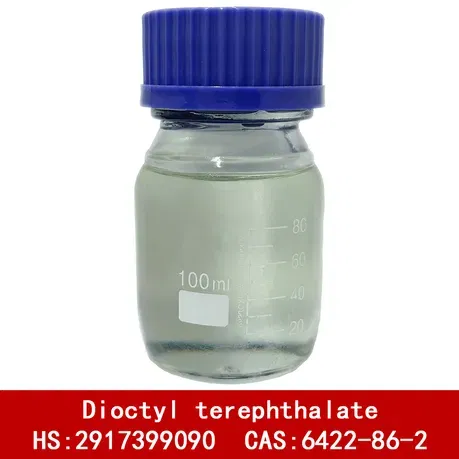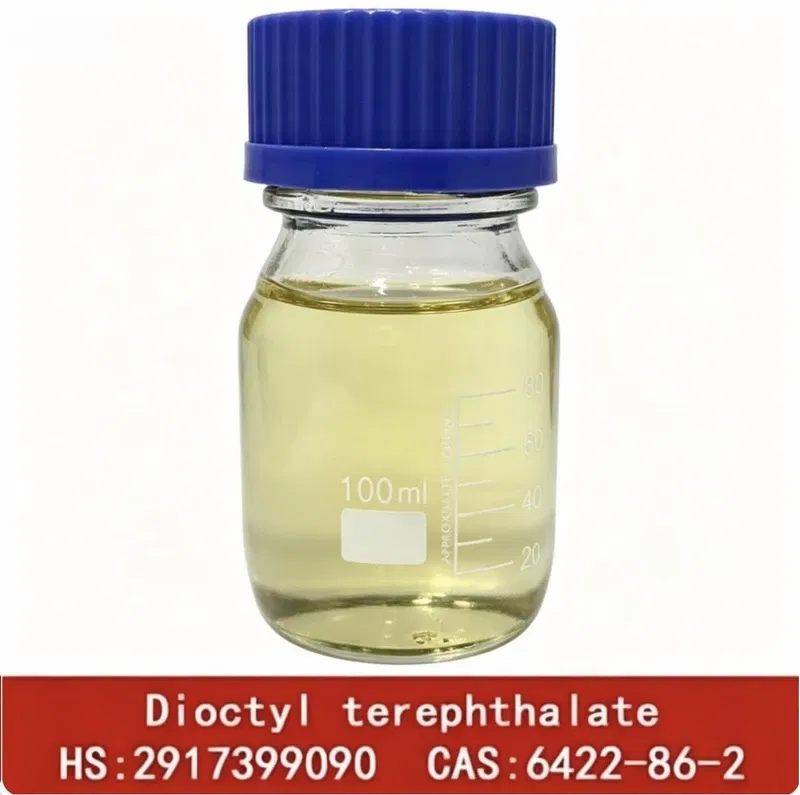

DOTP (dioctyl terephthalate) dosage in flexible PVC usually lands between 40 and 70 phr. Where a compound sits inside that band is set by the product: cable insulation is held at the low end by electrical and heat-ageing limits, while glove plastisol and soft footwear straps sit near the top. phr means parts per hundred resin by weight, so 50 phr is 50 kg of DOTP per 100 kg of PVC resin.
Two people read this page: a formulator who wants a starting number, and a buyer who wants to check one. The table below covers seven product families. What follows explains which variables move the number, what fails at either end, and how phr turns into kilograms on a purchase order.
Every range below is an industry-common starting band, rounded to 5 phr. It is not a Shandong Changxing specification and not a guaranteed value. Resin K-value, filler loading, stabiliser package, lubricant balance and the machine decide the final number, and only a trial on your own line can confirm it.
Plasticizer phr: what the unit means in a PVC compound
phr is a ratio, not a percentage. The resin is fixed at 100, and every other ingredient is counted against it:
phr = (kg of additive ÷ kg of PVC resin) × 100
50 phr = 50 kg DOTP per 100 kg resin. The same compound expressed as weight percent is 50 ÷ (100 + 50 + other parts) × 100.
This is why DOTP content in PVC is always quoted in phr rather than percent. A compound with 50 phr DOTP and no filler is about 33% plasticizer by weight. Add 40 phr calcium carbonate and the weight share falls to roughly 26%, even though the phr has not changed. Buyers who compare "percent plasticizer" across suppliers are often comparing different filler loadings.
Keep the denominator clean. Some plants calculate phr against resin plus filler by mistake. That understates the plasticizer and produces a compound harder than the trial sheet predicted.
DOTP dosage by application: the reference table
Read it as a route map, not a recipe. The hardness column is what the band usually delivers in a general-purpose compound; your filler and resin will shift it by a few points.
| Application | DOTP, phr | Usual hardness | What sets the band |
|---|---|---|---|
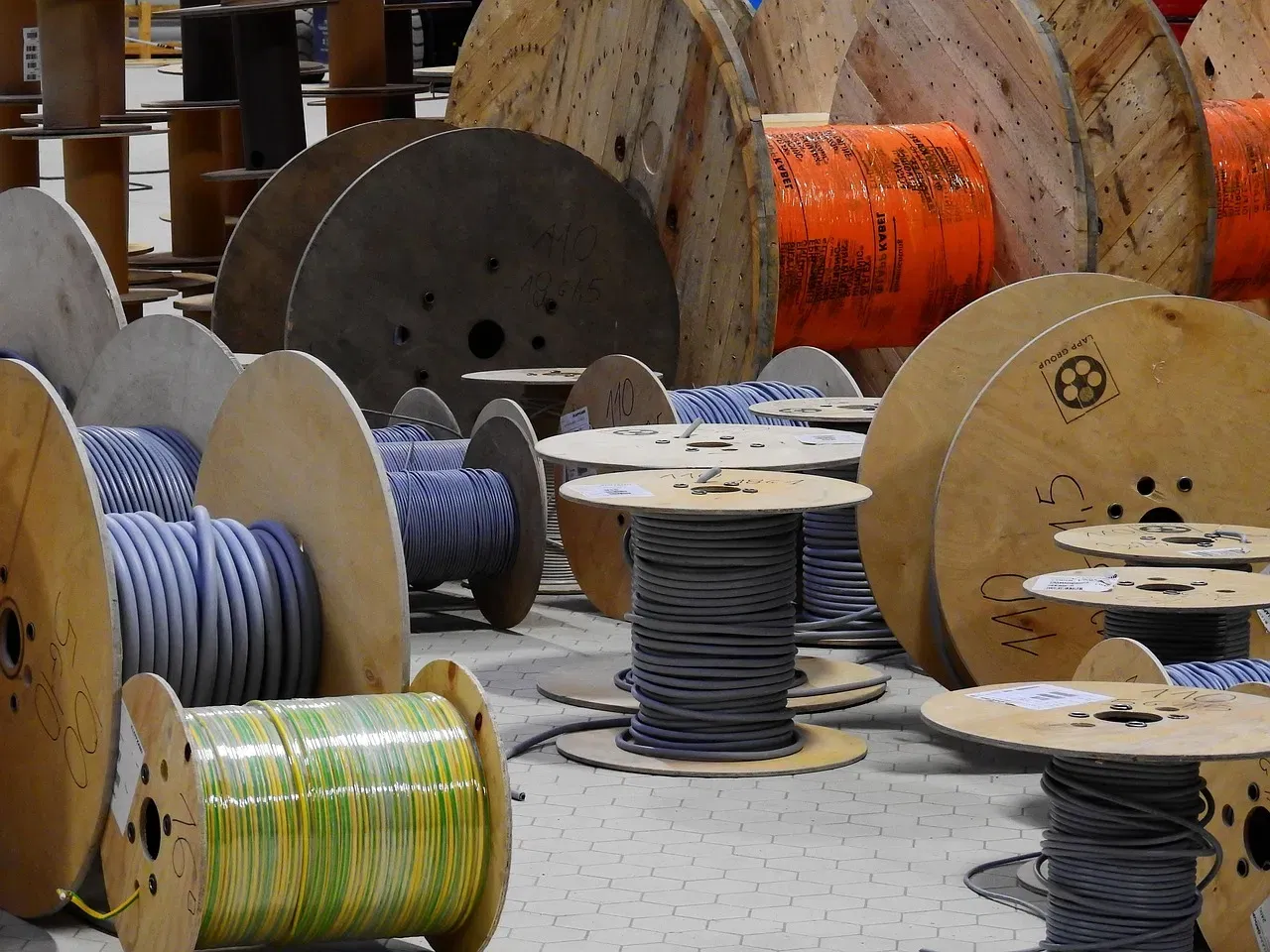
| Cable insulation | 45–60 | Shore A 75–85 | Volume resistivity and heat ageing; 90 °C and 105 °C grades sit low |
| Cable sheath | 50–65 | Shore A 70–80 | Cold bend and flexibility; heavy filler and carbon black |
| Film and sheet | 45–65 55–75 for agricultural cover | Shore A 65–85 | Calender or blown film, blocking, food-contact rules |
| Synthetic leather | 40–60 coating and foam 55–75 furniture upholstery | Shore A 50–75 | Hand-feel, embossing, migration into the backing |
| Footwear | 50–70 unit sole 60–80 boot 80–95 soft strap | Shore A 55–85 | Abrasion, flex resistance, target hardness |
| Gloves | 45–70 | Shore A 55–75 | Plastisol viscosity, extraction, hand feel |
| Hose | 40–70 | Shore A 60–85 | Pressure duty, cold flexibility, media contact |
Industry-common starting ranges. Nothing in this table is a Changxing specification or a guaranteed value; run your own trial before a band goes on a batch sheet.
Why DOTP content in PVC varies: six variables that move the number
Two compounds can both be "flexible PVC" and still need different plasticizer loadings. These six variables explain most of the gap.
| Variable | What it does to the dosage |
|---|---|
| Target hardness | The primary driver. Each additional 5 phr lowers hardness by roughly 3–4 Shore A points in a general-purpose compound, flattening as loading rises. |
| Filler loading | Calcium carbonate adds bulk and stiffness. A heavily filled compound needs more plasticizer to reach the same hardness, which eats into the gain from cheap filler. |
| Service temperature | Hot service accelerates volatilisation and ageing. Cable insulation and automotive parts keep loading low, or move to a higher-molecular-weight plasticizer. |
| Electrical requirement | Plasticizer raises ionic mobility. Insulation compounds trade softness for resistivity and stay at the bottom of the band. |
| Media contact | Water, oil, detergent and sweat extract plasticizer. Gloves, hose and footwear linings lose hardness over service if loading sits too high. |
| Process and thickness | Plastisol needs a viscosity window; calendered film needs release; thin parts lose plasticizer faster than thick ones. The machine narrows the band before the recipe does. |
These variables interact. A filled, thin, hot-service part can be pushed in three directions at once, and that is where a number copied from a data sheet stops working. Pick the band from the application, then let the trial settle the last 5 phr.
What happens when the DOTP dosage is too high
Above the working band the compound still feels soft, which is why over-dosing is easy to miss on the shop floor. The problems show up later, on the surface or in the test report.
- Surface tack and blocking. Free plasticizer migrates to the surface. Film sticks to itself on the roll, gloves feel greasy, and printed or laminated surfaces lose adhesion.
- Plate-out and die build-up. Plasticizer that the compound cannot hold is one of the species that collects on a cool die lip. The deposit appears after hours, not at start-up.
- Lower tensile strength and tear resistance. Elongation rises while the stress at break falls. Thin sections tear at the die or in service.
- Lower volume resistivity. More plasticizer means more mobility. Insulation compounds that drift upward in loading can fail an electrical test that passed last year.
- Migration into adjacent materials. Plasticizer moves into polystyrene, ABS, adhesives and coated fabric backing. The PVC hardens while the neighbour softens or crazes.
- Higher cost per tonne of compound. Plasticizer is usually the most expensive major ingredient after resin. Every extra 5 phr is paid for on every batch.
If the surface is tacky but the hardness is on target, suspect absorption before you cut the dosage. An under-fused compound behaves like an over-plasticised one, and reducing phr will not fix the mixing. The plate-out troubleshooting guide covers that case in detail.
What happens when the DOTP dosage is too low
Under-dosing is less common on a running line because the product feels wrong immediately. It still happens when a formula is copied from a harder product or when filler is increased without rebalancing.
- Hard, stiff parts. Shore A climbs, hand-feel turns boardy, and snap-fit or gasket products lose sealing force.
- Cold-flex failure. The compound cracks in a low-temperature bend test, and hose or cable installed outdoors fails in winter.
- Under-fusion in dry blend. Resin grains never absorb the plasticizer fully. The melt looks grainy, the surface is dull, and mechanical values scatter from batch to batch.
- Higher melt viscosity. Torque, head pressure and die pressure rise. Output drops, and the line runs hotter to compensate, which shortens the processing window.
- Brittle thin sections. Film, glove fingers and cable insulation crack at the die lip or during winding.
Before adding plasticizer, check that the batch actually received what the batch sheet says. Weighing errors, a pump calibration drift and a missed pre-heat all look like under-dosing.
Application notes: where each band comes from
The notes below explain where each DOTP dosage band comes from, and which ones need a local adjustment.
Cable insulation: 45–60 phr
General-purpose 70 °C insulation sits in the middle of the band. 90 °C and 105 °C grades move toward the lower half, because heat ageing and volatility matter more than softness. The compound also has to hold volume resistivity, and plasticizer loading works against that target. Our DOTP for wire and cable page sets out the insulation and sheath positions in more detail.
Do not raise loading to fix a cold-bend failure on an insulation compound without checking the electrical result. A softer compound that fails resistivity is not a fix. Grade choice belongs in the same conversation as dosage; the insulation and sheath grade guide covers the colour and resistivity side.
Cable sheath: 50–65 phr
Sheath compounds carry more filler and carbon black than insulation, so the same phr produces a harder material. The band sits slightly above insulation because sheath is judged on cold bend, abrasion and installation handling rather than resistivity. Black sheath usually takes the qualified grade, where a higher colour number does not matter. The qualified DOTP for wire and cable page covers that grade.
Film and sheet: 45–65 phr, up to 75 for agricultural cover
Calendered film typically runs around 50 phr. Blown film runs slightly lower because the bubble needs melt strength. Greenhouse and tunnel covers go higher for flexibility and low-temperature toughness, but the top of that range increases blocking risk and migration into the crop-facing surface. Food-contact film adds a separate constraint on which plasticizer may be used at all.
The DOTP for film and sheet page lists the sub-application bands, and the PVC film grade guide compares them by film type.
Synthetic leather: 40–60 phr in the coating and foam, 55–75 in furniture upholstery
Synthetic leather is not one compound. A top coating and the foam layer under it usually run 40–60 phr: enough plasticizer to flow and emboss, not enough to leave the surface tacky and picking up dirt. Furniture upholstery runs higher, 55–75 phr, for a soft hand. The backing and the adhesive matter too: plasticizer that migrates into either one shows up as delamination or a stiff hand after a few weeks.
The DOTP for synthetic leather page covers coating and foam positions, and the artificial leather formulation guide breaks the ranges down by end use.
Footwear: 50–70 phr for unit soles, 60–80 for boots, 80–95 for soft straps
Footwear splits by hardness and by flex duty. A unit sole at Shore A 75–85 needs less plasticizer than a boot compound at Shore A 65–75. Soft fashion straps and sandals can run far higher, but abrasion and tensile strength fall as loading rises, so the compound has to pass a flex test rather than only a hardness check.
The DOTP for footwear page gives the sole and boot positions. For the trial sequence, including Rossflex and DIN abrasion, see the shoe sole conversion guide.
Gloves: 45–70 phr
Gloves are usually plastisol, so the upper limit is set by viscosity and by how much plasticizer the fused film can hold without feeling oily. Household and dishwashing gloves sit at 45–65 phr. Disposable examination gloves run 55–70 phr, where the extra plasticizer buys the softness and fit the product needs; pinhole rate is controlled by the film and the process rather than by holding the loading low. Industrial and chemical-protective gloves sit around 60–70 phr. Sweat and detergent extraction shorten service life at the top of the band.
The DOTP for PVC gloves page covers the plastisol position, and the household glove guide explains the viscosity window.
Hose: 40–70 phr
Hose spans a wide band because pressure duty and flexibility pull in opposite directions. A semi-rigid suction hose needs wall stiffness and sits near 40–50 phr. A garden or irrigation hose runs 50–65 phr. Very soft delivery hose can reach 70 phr, but pressure rating and cold flexibility both have to be tested. Water, oil and fuel contact also extract plasticizer, so the compound may need a higher-molecular-weight plasticizer rather than more phr.
Pressure rating and cold flexibility are tested, not read off the phr number, and extraction depends on the plasticizer chosen rather than on how much of it went in.
Converting a DOP or DINP formula to DOTP
DOTP is slightly less efficient than DOP by weight, so a one-for-one swap at the same phr usually gives a harder compound. Most plants add 2–5 phr and then adjust from the trial result. Start at the middle of that range, +3 phr, and keep the stabiliser, filler and lubricant unchanged so that only one variable moves.
Fusion can shift as well. DOTP gels a little more slowly in some dry blends. If the compound looks grainy or the surface is dull, raise the mixing temperature or extend the mixing time before adding more plasticizer. A compound that is under-fused and over-plasticised is the worst of both cases.
How to set your own starting number
A published band only gets you close. Five steps turn it into a number you can put on a batch sheet.
- Pick the band from the application table, then choose the middle of the range, not the edge.
- Run a three-point ladder: the midpoint, minus 3 phr and plus 3 phr. Keep everything else identical.
- Measure Shore A after 24 hours, not straight from the press. Plasticizer keeps diffusing and hardness drifts in the first day.
- Test the property that fails in service: cold bend for cable and hose, Rossflex for footwear, tensile and elongation for film and gloves, heat ageing for 90 °C and 105 °C cable.
- Choose the lowest loading that passes. Extra plasticizer above the passing point buys softness you did not ask for, at a cost you pay on every batch.
Record the resin lot, filler lot and mixing conditions next to the result. A dosage that works on one resin lot can miss by 3 phr on the next, and the record is what lets you tell a formulation problem from a raw-material problem.
Buying by phr: what the number means on a purchase order
phr is also a purchasing number, because it fixes how many tonnes of plasticizer a given resin throughput will consume. At 50 phr, one tonne of resin takes 500 kg of DOTP. In a compound made only of resin and plasticizer, one tonne of compound contains about 333 kg of DOTP. Filler and other additives lower that share.
Use the calculation to size orders, not to describe the material. A purchase order should carry the grade and the specification limits, not a phr figure. For standard DOTP the limits we publish are ester content ≥98%, acid value ≤0.035 mg KOH/g, moisture ≤0.1% and colour ≤150 APHA; first grade runs to ≤230 APHA and qualified grade to ≤450 APHA.
Ask for a batch COA with the delivery and check the colour number against the grade you ordered. Colour drift is the first sign of a different feedstock or a process upset, and it shows up long before a hardness problem reaches the line. The DOTP product page lists the full specification.
Frequently asked questions
What is a typical DOTP dosage in PVC?
Flexible PVC compounds usually run 40–70 phr DOTP. Cable insulation sits at 45–60 phr, cable sheath 50–65, film and sheet 45–65, synthetic leather 40–75 depending on layer, footwear 50–95 and gloves 45–70. These are industry-common starting bands, not a specification; the formulation trial sets the final number.
Is the DOTP dosage the same as DOP?
Close, but not identical. DOTP is slightly less efficient by weight, so most plants add 2–5 phr when they replace DOP one-for-one at the same hardness. Keep the stabilizer and filler unchanged for the first trial, then adjust only the plasticizer.
What happens if I add too much DOTP?
The compound can turn tacky, bleed at the surface and plate out on the die. Tensile strength falls, volume resistivity drops, and plasticizer can migrate into adjacent materials. In thin film and gloves the excess also shows up as blocking or a greasy hand.
What happens if the DOTP dosage is too low?
The compound gets hard and stiff, cold flexibility fails and thin parts crack. Melt viscosity rises, so the line may need more torque or a higher die pressure, and dry-blend compounds can run under-fused.
How do I convert phr to kilograms?
phr is kilograms of plasticizer per 100 kg of PVC resin. At 50 phr, 100 kg of resin takes 50 kg of DOTP. In a compound made only of resin and plasticizer, that is 333 kg of DOTP per tonne of compound; filler and other additives lower the weight share but do not change the phr.
Does DOTP loading affect volume resistivity?
Yes. More plasticizer generally lowers volume resistivity, which is why insulation compounds stay in the 45–60 phr band and use a grade that meets the cable standard. Sheath compounds have more room, and black sheath usually takes the qualified grade.
Need a starting point for your compound?
Send the application, target hardness and current plasticizer loading. Shandong Changxing Plastic Additives Co., Ltd. supplies DOTP in three grades from ISO 9001 / 14001 / 45001 / 50001 certified production, and we will tell you which band applies to your product before you run a trial.
Ask for a dosage recommendation and sample- ✓ Superior 150 APHA, first-grade 230 APHA, qualified 450 APHA
- ✓ Ester content ≥98%, acid value ≤0.035 mg KOH/g, moisture ≤0.1%
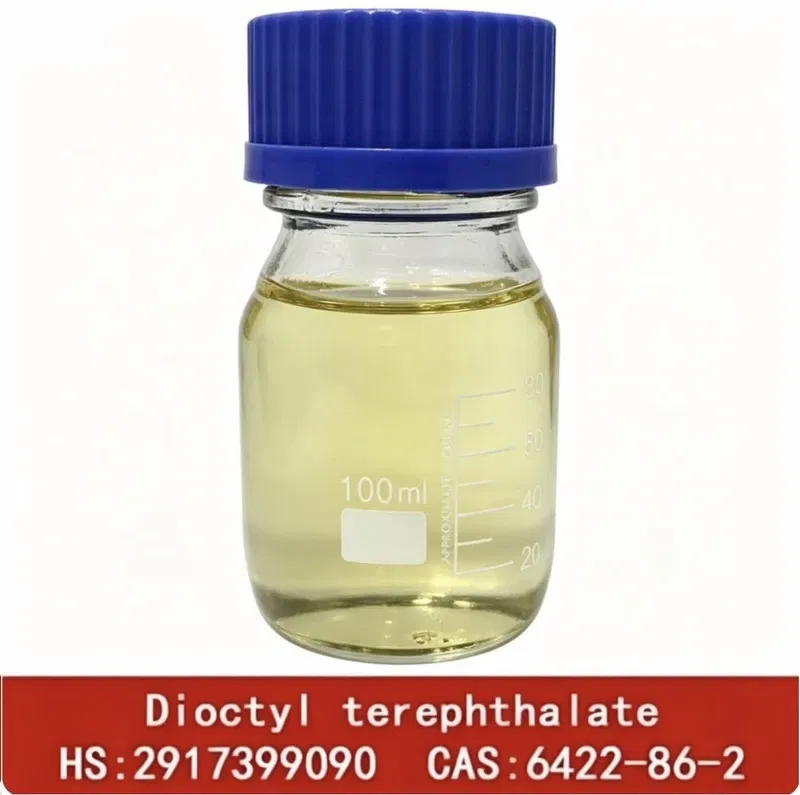
- ✓ CAS 6422-86-2, HS 2917399090; ISO 9001 / 14001 / 45001 / 50001 certified
- ✓ 230,000 tonnes of annual plasticizer capacity upon full completion
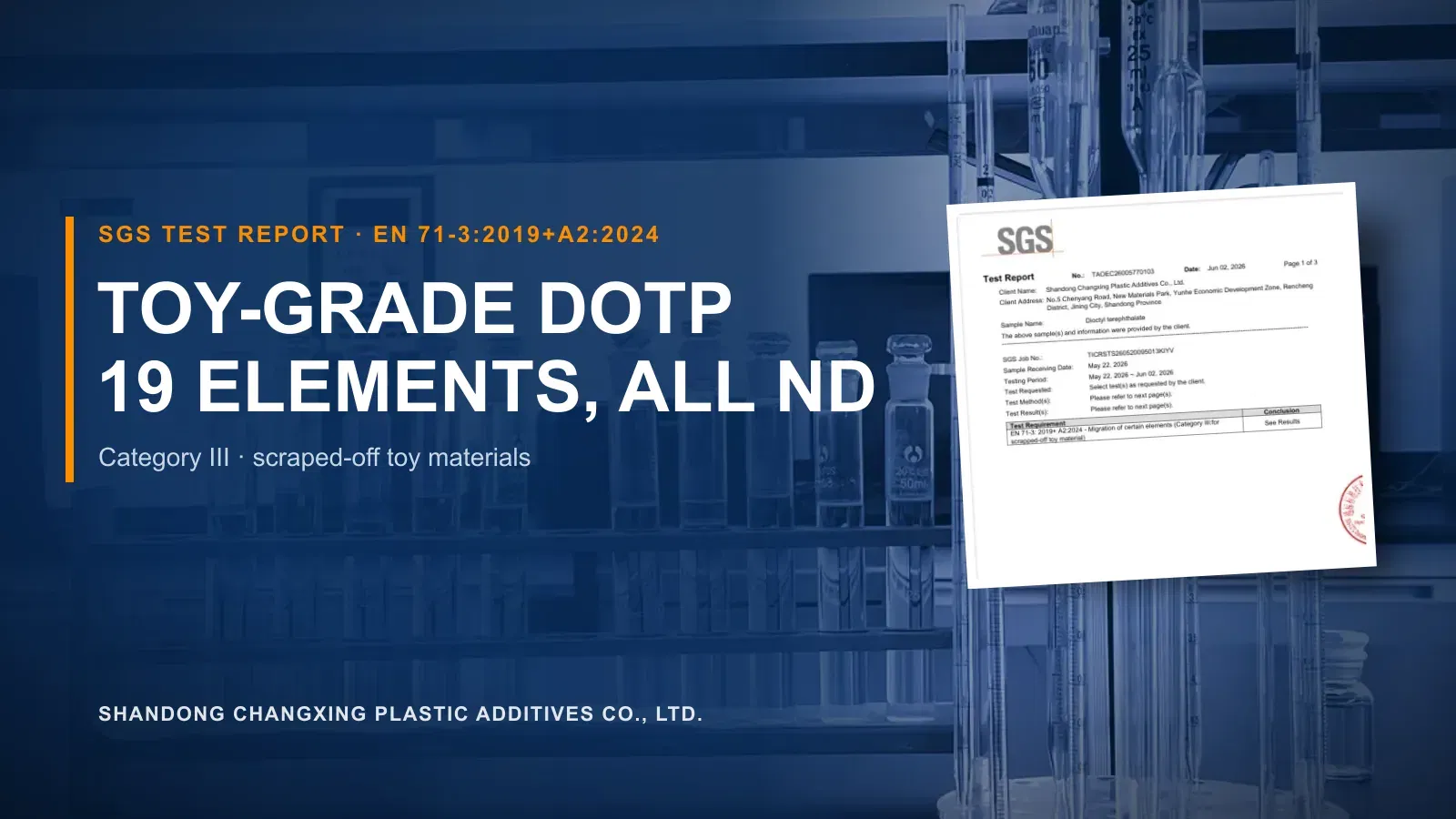
- ✓ SGS reports on file: phthalates not detected, EN 71-3 element migration, PFAS total fluorine screening